








 Last Updated: October 15, 2025
AI agents are no longer just a future vision; they’re already here, with businesses rapidly embracing them. Currently, around 17% of companies have fully adopted AI agents, and this figure is set to rise.
But here’s the catch: not all AI agents are created equal. The real question is whether to choose vertical AI agents built for specialized, high-accuracy tasks, or horizontal AI agents that work across multiple functions.
The choice matters because the right AI agent can shape the success of your strategy. That’s why it’s critical to understand what vertical AI agents are, how they differ from horizontal AI agents, and which one is best for your business.
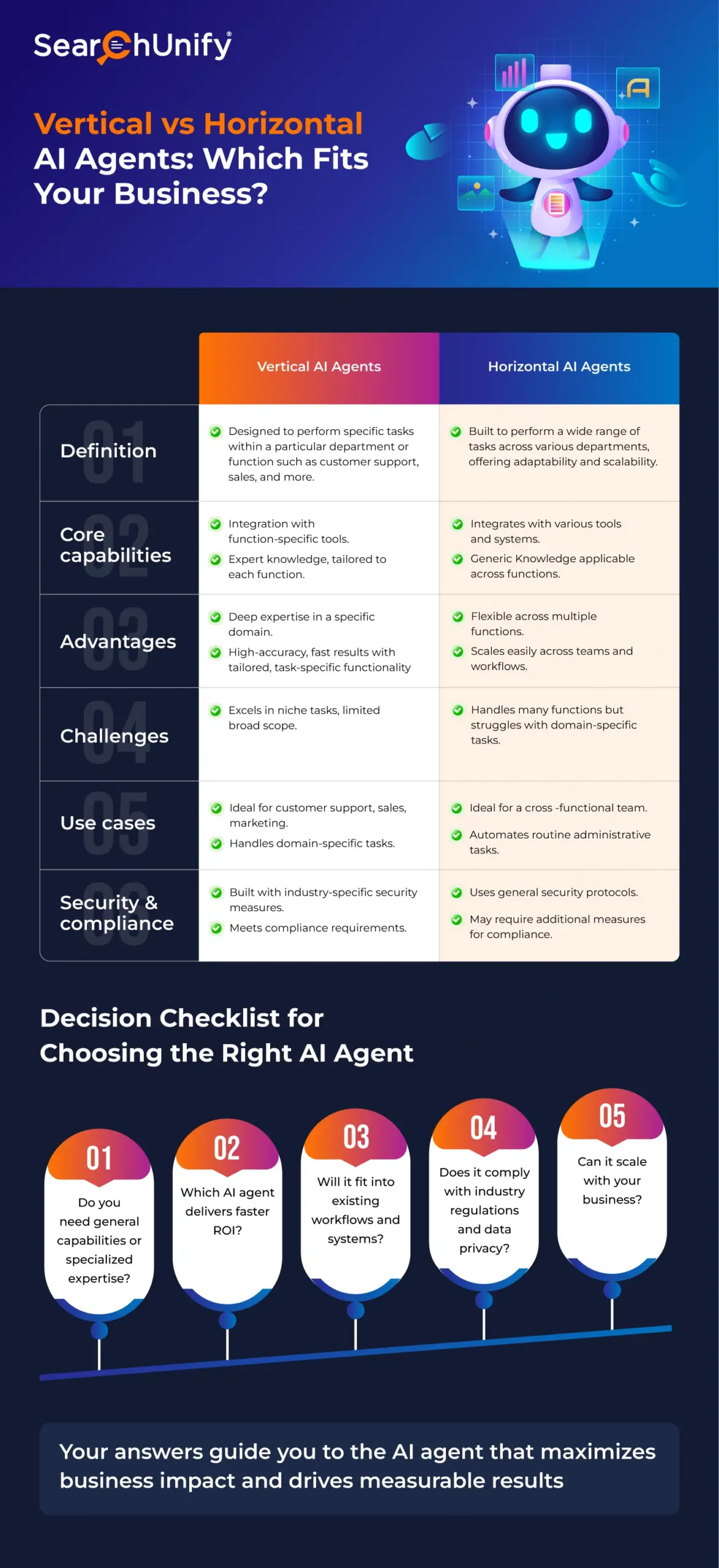
To view this infographic in high resolution, click here.
Conclusion
Choosing the right AI agent means aligning capabilities with your business needs. Horizontal AI agents offer flexibility and scalability across multiple functions, while vertical AI agents excel in specialized, high-impact tasks with fast ROI.
In customer support, a vertical AI approach like the SearchUnify Agentic AI suite has proven to be a game-changer. The suite includes AI agents purpose-built for self-service, case resolution, quality checks, and agent productivity.
To learn more about these agents, click here!
FAQs
What is the difference between vertical and horizontal AI agents?
Vertical AI agents are specialized for a specific function or domain, such as customer support, sales, or marketing. They provide deep expertise, high accuracy, and fast results in their niche.
However, horizontal AI agents are general-purpose and work across multiple functions or departments. They offer flexibility, scalability, and broader applicability, but may lack deep domain expertise.
What are vertical AI agents?
Vertical AI agents are AI solutions designed to perform tasks within a specific domain or function, such as handling customer support queries or optimizing sales processes. They are purpose-built for high accuracy, specialized workflows, and function-specific integration, making them ideal for tasks that require domain knowledge and quick, measurable impact.
What are the advantages of vertical AI agents?
The advantages of vertical AI agents include deep domain expertise, high accuracy and efficiency for specialized tasks, faster ROI through optimized performance in their niche, and built-in industry-specific compliance and security measures.
Which is better: vertical or horizontal AI agents?
It depends on your business needs.
- Vertical AI agents are better if you need specialized, high-accuracy performance in areas like customer support, sales, or marketing. They deliver fast ROI and domain-specific insights.
- Horizontal AI agents are better if you need flexibility across multiple teams or functions, such as automating routine workflows or scaling AI broadly.
The best choice comes down to whether your priority is deep expertise in a niche (vertical) or broad adaptability (horizontal).


