





 Last Updated: September 9, 2025
Gartner predicts that Agentic AI will autonomously resolve 80% of customer service issues by 2029. But reaching that milestone isn’t just about deploying AI, it’s about having AI agents for customer service that are specifically designed for self service.
That’s where purpose-built AI agents for self-service come in—they transform self-service from reactive to proactive, resolution-first experiences. These agents are redefining how customers find answers and turning self-service into a true growth driver. The race toward smarter, resolution-first AI is already underway.
In this era of AI-driven service, leveraging purpose-built AI agents isn’t optional, it’s the key to faster resolutions, happier customers, and a stronger bottom line.
Let’s dive in!
Table of Contents
- Purpose-Built AI Agents for Self-Service: Powering Resolution-First Experiences
- Inside the Engine: The Mechanics of AI Agent–Driven Self-Service
- Why Choose AI Support Agent to Transform Self-Service Experience
- The Road Ahead: What’s Next
Purpose-Built AI Agents for Self-Service: Powering Resolution-First Experiences
Self-service is often the first touchpoint in a customer’s journey, and its effectiveness directly shapes customer satisfaction and loyalty. When self-service fails to solve customers’ queries, it frustrates them, increases escalations, and ultimately impacts retention and brand trust.
However, purpose-built AI agents for self-service address these challenges by delivering precise, personalized solutions that resolve issues efficiently.
For instance, AI Support Agent, a dedicated agent within the SearchUnify Agentic AI suite explicitly designed for self-service, goes beyond answering queries to provide accurate, reliable resolutions. It comprehends the full query context and customers’ exact needs, making self-service fast, seamless, and frustration-free.
Inside the Engine: The Mechanics of AI Agent–Driven Self-Service
Purpose-built AI agents fuel smarter self-service support using a dynamic and flexible workflow. To understand this, let’s take a closer look at how AI Support Agent works in collaboration with other agents within the SearchUnify Agentic AI suite to deliver next-level self-service.
When AI Support Agent receives a customer query, the first step is to classify whether the query is for self-service or a service request. To perform this action, the AI Support Agent collaborates with the AI Classification Agent. This agent further checks with the AI Knowledge Agent whether there’s information in the knowledge base (KB) to solve this query or if it’s an entirely new support case.
Based on the query type, the AI Support Agent follows different paths to resolve customer issues efficiently:
- Known Cases: When AI Support Agent identifies that the customer query matches helpful articles in the knowledge base (KB), it taps into the KB and uses LLMs to generate accurate, human-like responses tailored to the query. It elevates self-service, ensuring customers feel understood while receiving precise resolutions, while also citing sources for credibility and authenticity.
- New Cases: If no relevant knowledge exists in the KB, the AI Support Agent takes charge, creating a support ticket and seamlessly handing it off to a live agent with full case context.
- Complex Cases: If the query requires deeper expertise, AI Support Agent can create a case and move it to another AI agent (like an L2 Agent) for advanced handling, keeping the process smooth and efficient.
- Urgent Cases: By leveraging sentiment analysis, the AI Support Agent detects urgency in the customer’s query (e.g., “still not able to log in”). In such scenarios, it can create a case and ensure a seamless handoff to a live agent with full context, so the customer gets priority attention and prevents escalation.
Moreover, the AI Support Agent isn’t tied to a fixed workflow. It can plan and execute on the go, with triggers configurable via natural language instructions through the admin panel. This flexibility, combined with its deep support expertise and out-of-the-box integration with multiple content sources, makes it highly reliable and effective in enhancing self-service.
Ready to see how AI Support Agent can transform your self-service support?
Talk to UsWhy Choose AI Support Agent to Transform Self-Service Experience
Here’s why AI Support Agent is the go-to solution for enhancing self-service:
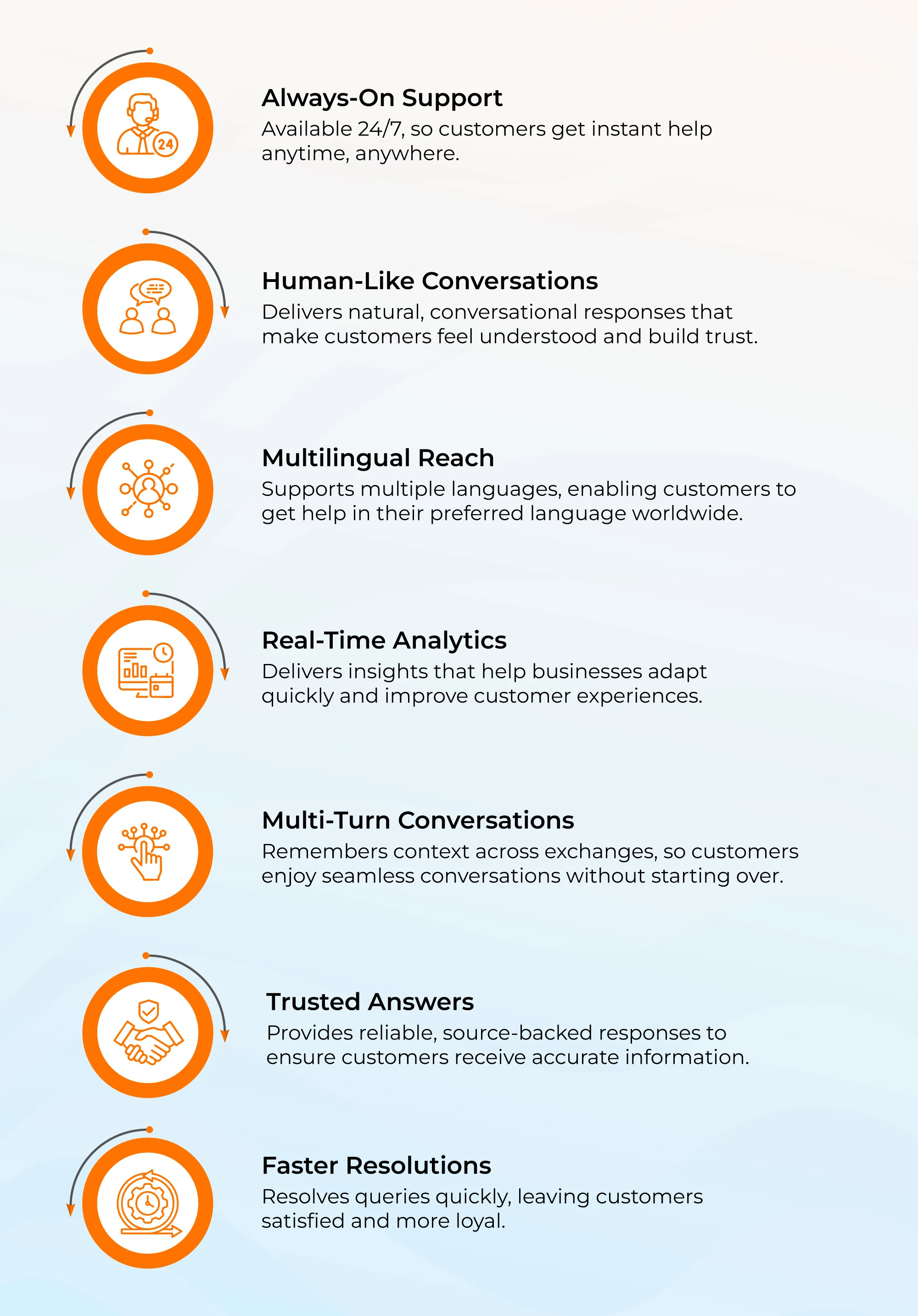
The Road Ahead: Selecting the Right AI Agent for Customer Self-Service Support
Not all AI agents in the market can deliver a seamless self-service experience. To provide instant, accurate, context-aware, and personalized responses, organizations need AI agents purpose-built for self-service.
AI Support Agent transforms self service support from reactive to proactive, resolving queries efficiently, reducing friction, and delighting customers.
Curious how the AI Support Agent can streamline your self-service? Let’s Connect
FAQs
Why is selecting the right AI agent critical for customer self-service?
Selecting the right AI agent is critical for customer self-service because it’s often the first point of contact. If it fails, the entire support load falls on human agents, leading to burnout and reduced productivity. However, the right AI agent increases case deflection, lowering ticket volume and allowing agents to focus on strategic tasks that improve overall support outcomes.
What factors should I consider when choosing an AI agent for self-service?
When choosing an AI agent for self-service, ensure it is purpose-built for the role. It should integrate seamlessly with knowledge bases, CRM, and other support systems, understand user intent, deliver accurate, personalized responses, and scale effectively to handle growing query volumes. The agent should continuously learn from interactions, while its robust analytics provide insights to optimize workflows and improve overall support outcomes
How can I measure the success of an AI self-service agent?
The success of an AI self-service agent can be measured through key metrics:
- First-contact resolution rate: Percentage of queries resolved without human intervention.
- Reduction in escalations: Fewer cases requiring agent handoff indicate effective AI support.
- Customer satisfaction (CSAT) scores: Feedback from users interacting with the AI agent.
- Usage and adoption rates: High engagement shows customers trust and prefer the AI agent.


