



 Last Updated: January 27, 2026
Standalone AI agents are no longer enough. The next leap in customer support comes from connected, coordinated intelligence.
Early virtual assistants handled simple tasks like scheduling or FAQs, but customer expectations have moved far beyond that. Even the most advanced AI can’t manage every workflow or the complexity of today’s enterprise environments alone.
A study from Gartner that by 2028, 15% of daily business decisions will be made autonomously using agentic AI. It is a sharp rise from 0% in 2024. They also project that one-third of enterprise software will feature agentic AI by 2028, compared to less than 1% in 2024.
In customer support, this means companies are moving beyond simple chatbots to smarter, AI-powered agents. Data also suggests that 72% of CX leaders say these AI agents should act as an extension of their brand, mirroring its voice, values, and personality in every interaction.
As organizations adopt more AI agents across domains and vendors, their systems are becoming increasingly distributed. This increasing complexity necessitates orchestration that allows these agents to collaborate as well as connect. And aligning autonomous agents to collaborate rather than operate alone is where multi-agent orchestration becomes crucial.
This article explores how multi-agent orchestration works, its impact on customer support, and why it’s becoming critical for future-ready enterprises.
What is Multi-Agent Orchestration?
Multi-agent orchestration connects multiple AI agents, assistants, and data systems to operate as a unified network. It streamlines task execution through a single interface, removing the hassle of switching between tools or repeated logins. By breaking down silos across teams and systems, it improves knowledge sharing and helps organizations make decisions faster.
What problem does Multi-Agent Orchestration solve?
Over half of customers switch brands after just one poor experience – proof of how critical great support has become.
However, today, customer support is large and complex. There are multiple departments that need to be coordinated to successfully close one ticket. Quick knowledge sharing is crucial. Also, in industries like finance, support systems must protect sensitive data. They must also meet HIPAA and GDPR.
Support teams now serve customers across chat, email, and social media; often simultaneously. And customers expect smooth, 24/7 support from all of these channels. This diversity is captured by multi-agent orchestration that helps connect these channels and maintains a consistent experience.
Through orchestration, specialized AI agents work together to manage heavy workloads. They also keep data safe and compliant.
How Multi-Agent Orchestration Makes Customer Support Smoother?
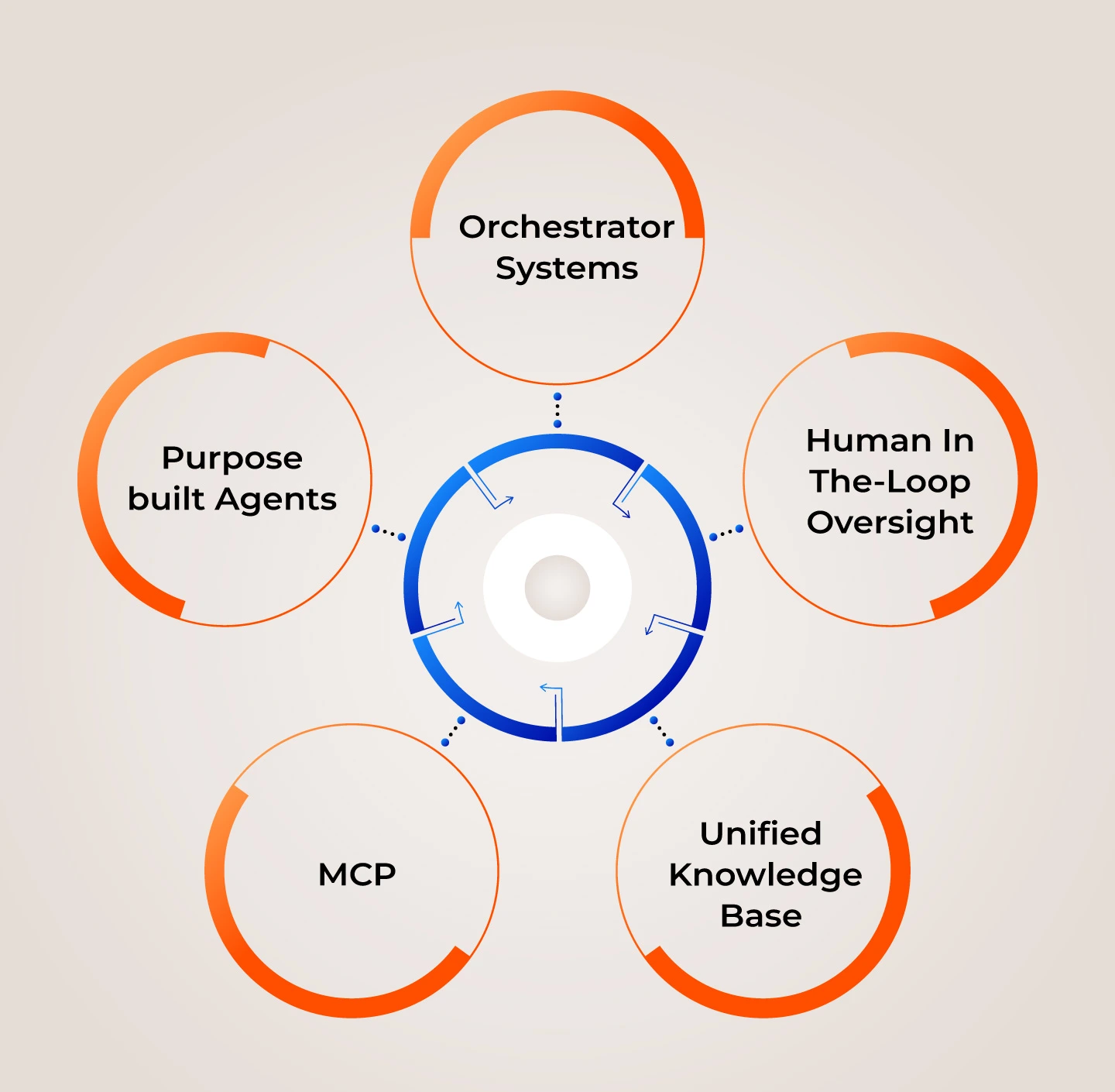
Orchestration brings order to the customer support lifecycle – matching each task with the most suitable AI or human agent. Each one specializes and works together. The outcome is faster, more precise, and consistent support across every stage. This is how multi-agent orchestration benefits the entire customer support lifecycle.
1. Case Intake: Smarter Triage from the Start
Manual ticket triage is slow and clunky. Agents wind up reading, tagging, and routing tickets by hand, and mistakes just drag things out. With orchestration, an AI intake agent jumps in right away. It reads the ticket, picks up on the language, sentiment, and context, and figures out what the issue is, how urgent it feels, and what the customer wants. Instantly, the system categorizes the case and drops it into the right queue or puts it in front of the right specialist. No more bottlenecks. Everything moves faster, agents focus on real work, and customers don’t end up waiting for someone to notice their problem.
2. Context Enrichment and Data Retrieval
Normally, agents bounce between the CRM, knowledge base, and old logs just to get the backstory. It’s tedious and easy to miss something important. With orchestration, a contextual agent does the legwork—pulling up customer history, product info, and past interactions from every connected system. All this lands right in the agent’s console, ready to go. Now, when agents pick up a ticket, they have the whole picture in front of them, making the conversation smoother and more confident.
3. Resolution Support and Team Collaboration
When cases get tricky, agents usually hunt around for answers or wait for help from an expert. Orchestration changes the game. A recommendation agent suggests the best next step or even ready-to-send resolutions based on the case. If the issue needs escalation, collaboration agents loop in the right experts or systems automatically—no chasing people down. Workflow agents track every step, making sure nothing gets lost in the shuffle. So, cases get resolved faster, fewer issues need to be escalated, and quality stays high.
4. Knowledge Capture and Continuous Learning
All too often, great solutions get buried in closed tickets. They never make it into the knowledge base. With multi-agent orchestration, a Knowledge agent summarizes resolved cases and updates the knowledge base right away. Later, a search intelligence layer uses those learnings. Thus, in future, similar queries get solved even faster.
5. Reporting, Insights, and Optimization
Support leaders know the pain of data scattered across a dozen tools. Orchestration fixes this. A governance and analytics agent pulls together all the key metrics from CRM, chatbots, and ticket systems. It shows real-time stats like First Contact Resolution, Customer Satisfaction, and Mean Time to Resolution all at once. These insights flow straight back into the orchestration layer, fine-tuning automation and workflows. The upshot? Total transparency, measurable results, and smarter decisions across the board.
Ready to see how Multi-Agent Orchestration can streamline your support workflows? Talk to a SearchUnify expert today.
Book A DemoWhat KPIs Improve with Orchestrated Support?
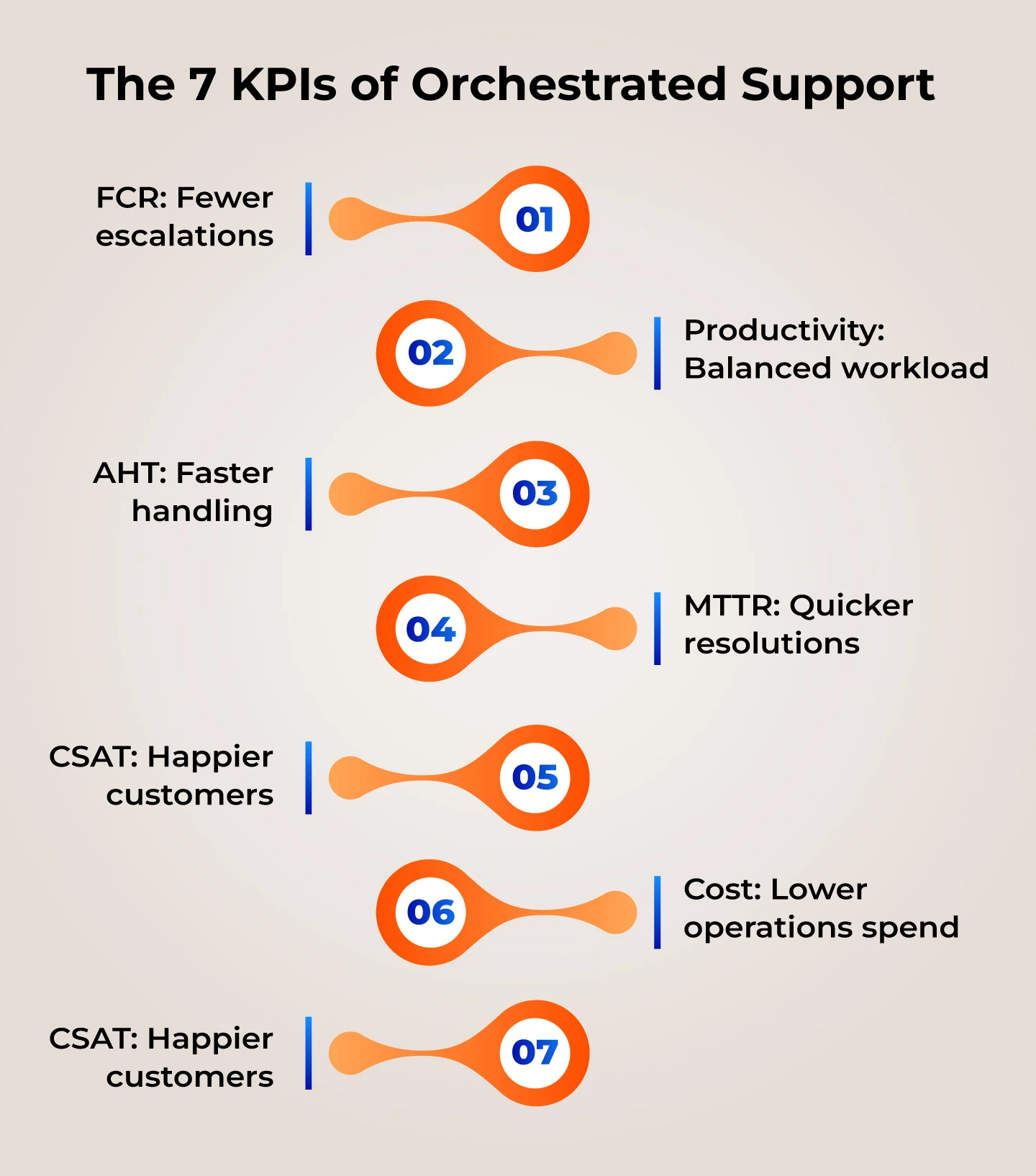
Every support team measures success by the same metrics – speed, satisfaction, cost, and efficiency. But as operations scale, maintaining those numbers gets harder. That’s where multi-agent orchestration delivers measurable impact. The system has specialized AI agents that actually work together, analyzing what customers want and routing tickets smartly.
Let’s break down what this actually means for critical KPIs.
1. First Contact Resolution (FCR): Customers want answers now. Orchestration lets AI agents tap into all companies’ systems and knowledge bases in real time, so they can solve simple issues on the spot and get smarter with every ticket. Fewer escalations, more problems solved right away.
2. Average Handle Time (AHT): AI takes over the routine tasks, including triaging tickets, jotting down notes, and updating data. Human agents get live recommendations and pre-filled info. The results are faster calls and chats, without sacrificing quality.
3. Customer Satisfaction (CSAT) & Net Promoter Score (NPS): When answers are fast, personal, and spot-on, customers notice. Orchestrated AI agents go beyond providing information – they understand tone, context, and help support teams respond more empathetically. Customers feel heard, and your CSAT and NPS climb.
4. Case Deflection Rate: Self-service gets a major upgrade. When virtual agents and backend systems work in sync, customers find answers on their own before they ever submit a ticket. Over time, the system learns and gets even better at solving problems up front, so your team can focus on the tough stuff.
5. Agent Productivity & Utilization: Nobody wants to waste talent on data entry. AI orchestration takes the admin work off manual agents’ plates and lets them focus on cases that matter. It also keeps workloads balanced, so everyone stays productive.
6. Mean Time to Resolution (MTTR): Cases move smoothly from one system or team to the next. Smart routing, automated follow-ups, and better visibility speed up every step, so customers aren’t left waiting.
7. Cost per Ticket: More automation, smarter deflection, and less rework drive down your service costs. With a unified AI layer, you also cut out duplicate tools. That means companies get more from their tech investments, not just adding to the pile.
How Can Enterprises Get Started with Multi-Agent Orchestration?
So if you are looking to streamline your customer support process and wow your customers with the experience, you may consider opting for Agentic AI Multi-Agent Orchestration with SearchUnify Agentic AI Suite. SearchUnify helps you solve key support challenges with speed and intelligence. Our AI-first approach improves agent productivity, enhances customer experience, and maximizes ROI through scalable automation. You can automate complex workflows with intelligent multi-agent orchestration. Your support operations can be a lot smoother and with less manual effort.
The SearchUnify Enterprise Agentic AI Platform gives technology leaders like you a secure foundation to build, deploy, and manage AI agents across any cloud or model.
If you’re ready to create your customer experience as the true growth engine for your business, our experts can help you deliver measurable impact.
Turn your customer experience into a growth engine. Book a strategy session with our AI experts.
Book A DemoThe Next Horizon: The Internet of Agents
So far, most orchestration has stayed within single enterprises. But that’s changing fast. The next wave of digital transformation will be powered by connected AI ecosystems. These will be networks where agents from different industries talk, trade, and work together in real time.
Success will depend on how well enterprise agents connect with outside systems and partners. Companies that build for openness, governance, and easy integration now will gain a big edge. Those who wait will struggle later with messy, disconnected systems.
The cost of delay is real. Every isolated agent added today increases friction, duplication, and integration problems. As the world moves toward smarter, cross-industry networks, businesses that make orchestration part of their AI strategy now will grow faster, spend less, and stay more resilient.
The key is to make orchestration a core strength today. Enterprises must lead, not follow, in the era of the Internet of Agents.
FAQ: Multi-Agent Orchestration in Customer Support
1. What is Multi-Agent Orchestration in simple terms?
It’s a system that lets multiple AI agents work together, where each handles a specific job to achieve a common goal efficiently.
2. How does multi-agent orchestration create a seamless user experience?
It reduces friction by having a single intelligent agent handle all user interactions. Behind the scenes, this agent coordinates with specialized agents, routes queries, and retrieves answers without making the user repeat information or lose context.
3. What are the steps in AI Agent Orchestration?
AI agent orchestration typically includes these steps:
- Plan: Define goals and use cases.
- Select agents: Pick specialized AI agents for each task.
- Implement framework: Set up the orchestration system.
- Assign roles: Map agents to specific workflows.
- Coordinate actions: Enable smooth collaboration.
- Share context: Manage data and memory access.
- Optimize: Monitor, learn, and improve continuously.
4. How can my enterprise start with Multi-Agent Orchestration?
You can begin by integrating orchestration within existing AI tools or adopting a scalable suite like SearchUnify’s Agentic AI platform.


