





 Last Updated: December 30, 2025
Have you ever been understaffed the moment a surge of customer queries hits? Many teams know this struggle well. The answer isn’t blind automation. Many customer service automation tools still fall short. They lack conversational depth, require heavy upkeep, or fail to deliver reliable resolutions.
High-volume escalations can drain even strong support teams. They slow response times and push ticket queues out of control. Instead of managing scattered systems and rising workloads, the better approach is customer service automation software that replaces repetitive tasks with real agentic intelligence.
But the big question remains – which customer service automation platform actually works?
To make your search easier, we reviewed 10 leading platforms that excel at handling heavy query loads and improving ticket flow.
Every business has its own priorities. Some need dynamic agent routing and smooth human handoffs. Others prefer fast, direct live chat support. But the goal stays the same: streamline customer service so your team can focus on what truly matters.
Let’s dive in.
What Is Customer Service Automation?
Customer service automation handles routine, repetitive tasks that don’t require human judgment. It can answer common questions, surface relevant knowledge, triage and route tickets, and guide users through self-service across chat, portals, or in-app flows. The goal isn’t to replace agents but to free them from busywork so they can focus on complex issues.
Today, great service is defined less by how fast teams reply and more by how effortlessly issues get resolved. Automation drives that shift – boosting accuracy, consistency, and overall efficiency. It’s why 88% of service professionals say AI helps companies better serve customers, and 83% believe expectations are higher than ever. As both expectations and operational complexity rise, teams need technology that creates real leverage. Modern automation platforms deliver that by combining AI, knowledge intelligence, and end-to-end workflows to enable faster, more reliable, and scalable support.
Why Enterprises Invest in Customer Service Automation?
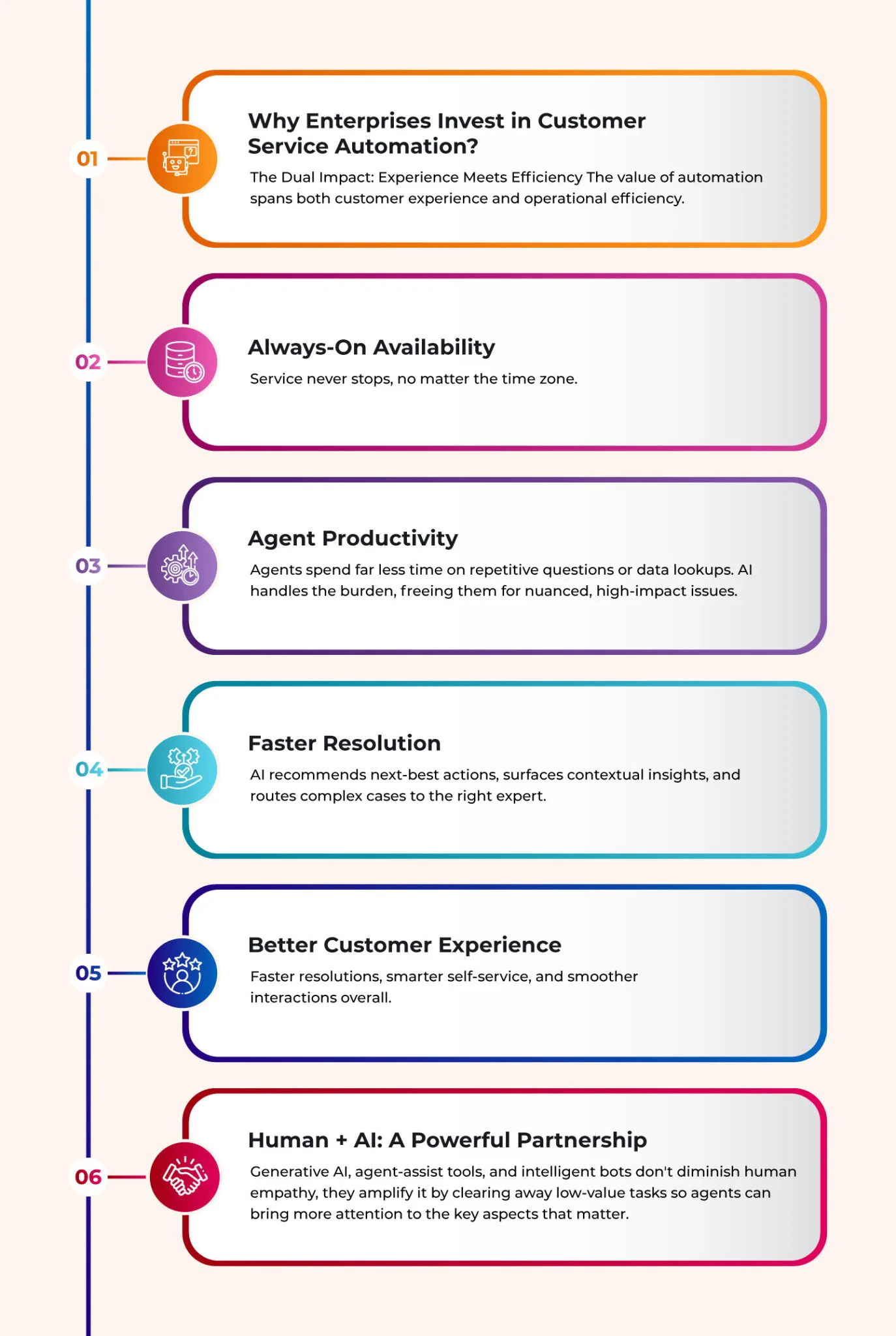
Customer service automation boosts both experience and efficiency by offering 24/7 support, faster resolutions, and reduced agent workload. By handling repetitive tasks, AI frees agents to focus on empathy and complex issues, creating smoother, more meaningful customer interactions.
What are the top 10 automation tools for customer service?
Ultimately, automation works best when it’s treated as a force multiplier. Modern agentic platforms help enterprises strike that balance with precision. Below is a concise, enterprise-focused guide to picking a customer-service automation platform.
1. SearchUnify Agentic AI Suite – Best for End-to-End Autonomous Support Operations
SearchUnify’s Agentic AI Suite delivers fully autonomous customer support across the entire service lifecycle – from frontline resolution and sentiment-based escalation to deep technical troubleshooting, knowledge creation, and QA auditing. Built on an enterprise-grade search backbone, it combines multi-level AI agents, intelligent routing, agent co-pilots, and continuous learning to improve accuracy, reduce manual workload, and accelerate case resolution at scale.
What makes it stand out:
- Multi-level AI agents for full support lifecycle
- Smart case creation, routing, and classification
- Deep troubleshooting with L2 AI engineers
- Agent co-pilot with productivity and QA insights
- Autonomous knowledge creation engine (Knowbler)
- AI-based case quality auditor
- Continuous learning loop
2. Agentforce by Salesforce
Salesforce Agentforce is an AI-powered platform for building and deploying autonomous digital agents that automate complex workflows across Sales, Service, and Marketing.
Highlights:
- Deep Salesforce integration for a unified customer view
- Low-code agent building with pre-built skills
- Advanced AI for autonomous actions
3. Zendesk
AI-driven support with quick setup, clean omnichannel tools, and automation that enhances self-service and agent productivity.
Highlights:
- Clean omnichannel support
- Solid automation flows + AI Answer Bot
- Integrations
- Easy to scale with growing teams
Upgrade Your Service Automation Strategy
Book a Demo4. ServiceNow Customer Service Management
AI-powered workflows built for heavy-duty orchestration, unified internal/external processes, and compliance-grade global scale.
Highlights:
- Workflow orchestration
- Strong GenAI and automation roadmap
- Unifies internal + external service processes
- Scalable and compliant
5. Genesys Cloud CX
A reliable call center CX platform, best suited for omnichannel-heavy operations, though TCO and technical demands suit enterprises over small teams.
Highlights:
- Reliable and smooth implementation
- Unified interface for all communication channels
- Administrative tools for efficient management
- AI features that enhance support quality
6. Fin by Intercom
No-code AI agents with smart bots, in-product onboarding, a strong developer ecosystem, and rapid iteration.
Highlights:
- Smart conversational bots
- In-product guidance and onboarding flows
- Developer ecosystem
7. Talkdesk
Cloud contact center with AI QA, solid routing, transcripts/recordings, and CRM-linked customer history for faster resolutions.
Highlights:
- Reliable cloud contact-center platform
- AI QA and workforce analytics
- Good routing and voice capabilities
8. Zoho Zia
Zia Agents are AI-powered bots designed to operate independently and provide human-like interactions across sales, marketing, service, and other business functions.
Highlights:
- Reliable customer-facing chatbot
- Automated lead qualification and follow-ups
- Built-in sales forecasting and performance insights
9. Freshdesk (Freshworks)
A cloud-based, AI-powered customer service platform that centralizes tickets from email, chat, phone, social, and messaging into a single help desk, with strong automation and reporting.
Highlights:
- Multichannel ticketing
- Freddy AI for chatbots and agent assist
- Scalable plans upto enterprise levels
10. HubSpot Service Hub
Tight sales – service alignment with simple workflow automation, clean reporting, and low operational effort in a single CRM ecosystem.
Highlights:
- Tight sales-service alignment
- Easy workflow automation
- Clean reporting
- Low operational overhead
Ready to Move Beyond Basic Automation?
The right customer service automation platform can transform how your team works. It handles complexity at scale, integrates with your existing systems, and continuously improves over time. Enterprises that deploy agentic, knowledge-first automation see faster resolutions, lower costs, and stronger customer loyalty. The tools are proven. The ROI is clear. Now it’s all about execution.
Experience Agentic, Knowledge-First Support Automation
Book a DemoFAQ
1. What types of customer queries can automation handle effectively?
Automation works best for routine, repetitive queries like password resets, order status checks, account updates, billing questions, and FAQ-type inquiries. Complex issues requiring judgment, empathy, or policy exceptions still need human agents.
2. How does customer service automation actually reduce ticket volume?
Automation deflects repetitive queries through AI agents, self-service flows, and smart triage – resolving common issues instantly and routing only complex cases to agents, which lowers ticket load and speeds up resolutions.
3. Can customer service automation replace human agents completely?
No. Automation complements agents by handling routine tasks and lookups, while humans manage complex issues. This combined model boosts efficiency, CSAT, and overall support quality.
4. What should enterprises look for when choosing customer service automation tools?
Enterprises should prioritise multichannel AI support, strong CRM/ticketing integrations, low-code workflows, analytics, scalability, clear pricing, and enterprise-grade security to ensure high performance and better CX.
5. How does customer service automation integrate with existing systems?
Most platforms connect with CRMs, ticketing systems, knowledge bases, and communication channels through APIs and pre-built integrations. This allows automation to pull customer data, create tickets, update records, and work across multiple tools without manual intervention.
6. What are the key implementation challenges with customer service automation?
Common challenges include integrating with legacy systems, training AI on company-specific knowledge, maintaining data quality, managing change with support teams, and ensuring the automation handles edge cases properly without frustrating customers.


