





 Last Updated: February 2, 2026
For many medium and large organizations, customer support outsourcing has long been the fastest way to check two critical boxes: cost efficiency and operational scale. As companies grow across markets and time zones, outsourcing promises 24/7 availability without the burden of building large in-house teams.
This model worked until customer expectations changed.
Today, customer support is no longer a back-office function. It sits at the center of brand perception, retention, and lifetime value. Recent research indicates that customer service plays a pivotal role throughout the customer journey, influencing brand choice for nearly half of consumers (49%), driving retention for more than half (54%), and shaping overall brand perception for the majority (58%).
Even more telling, Salesforce observes 88% of customers say they are likely to repurchase after a positive service experience.
Outsourced support teams were never designed for this reality. And that gap is now impossible to ignore.
Table of Contents
- Why Relying on Outsourced Customer Support is not Enough?
- What are the Hidden Costs of Outsourcing Customer Support?
- How Does Agentic AI Strengthen Support Operations?
- What is the ROI of Adopting Agentic AI in Customer Support?
- From Cost Center to Competitive Advantage
Why Relying on Customer Support Outsourcing is not Enough?
Customer support is one of the most commonly outsourced business functions, and for good reason.
The logic is:
- Lower labor costs
- Faster scaling during growth spikes
- 24/7 coverage across geographies
- Access to specialized operational expertise
Common models include offshore BPOs, shared agent pools, and third-party managed service providers. On paper, these approaches promise efficiency and scale. However, as support volumes grow and customer expectations rise, challenges appear.
Customer experience can suffer when agents handle multiple brands with differing tones, policies, and priorities, making interactions feel generic. High agent turnover compounds the issue, leading to repeated retraining, shallow product knowledge, and onboarding costs.
Managing quality also becomes harder, as indicators like CSAT or ticket backlogs may not surface problems early. These are not failures of outsourcing itself but reflect that traditional models were designed for transactional efficiency.
Modern customer support demands context-rich, relationship-driven engagement, exposing hidden costs that impact growth.
What are the hidden costs of Outsourcing Customer Support?
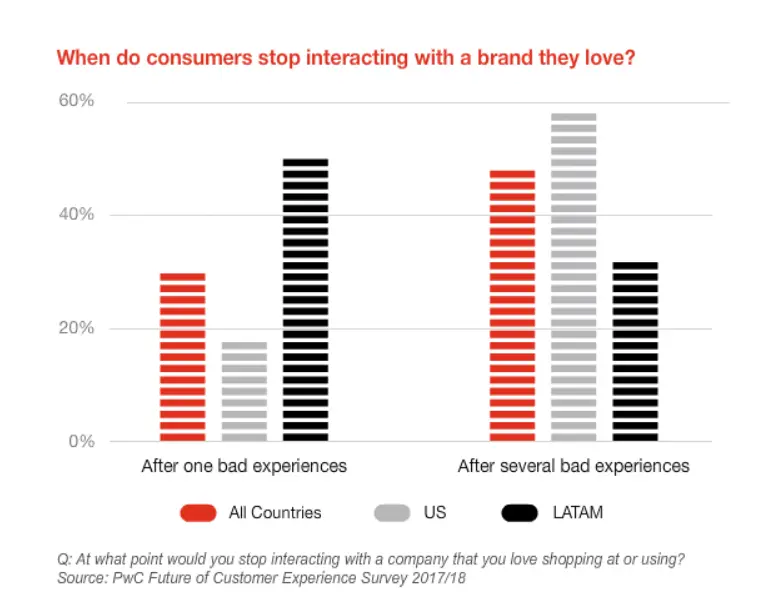
These structural limitations create costs that rarely appear on a balance sheet, but directly impact growth. Poor service experiences drive silent customer churn. In the U.S., even when customers like a company or product, 59% will walk away after several poor experiences, and 17% after just one. (PwC)
One immediate consequence is operational drag. When outsourced agents can’t resolve issues, escalations spill into internal teams. Product, engineering, finance, and operations become de facto extensions of support, increasing cognitive load and pulling attention away from core work.
Another is management overhead. Vendor governance, SLA negotiations, audits, retraining cycles, and tooling integrations demand continuous attention. Over time, leadership realizes they are managing the outsourcer almost as closely as an internal team, without the control.
There’s also customer churn and reputational risk. Poor support doesn’t always trigger complaints. More often, it triggers silent exits. Customers leave after repeated friction, slow responses, or inconsistent answers. Long before metrics signal a problem.
Data fragmentation compounds the issue. Customer interactions live inside vendor systems, CRM notes, ticketing tools, and spreadsheets. Insights remain siloed. Patterns that could prevent future issues go unnoticed because no system is accountable for learning.
Perhaps the biggest risk is loss of control over customer relationships. Outsourcing puts the most frequent customer touchpoint outside the organization. When brand trust is mediated by a third party with different incentives, alignment becomes fragile.
This is where many organizations begin exploring an alternative solution.
Looking to improve consistency and efficiency in outsourced support?
Learn MoreHow does Agentic AI strengthen support operations?
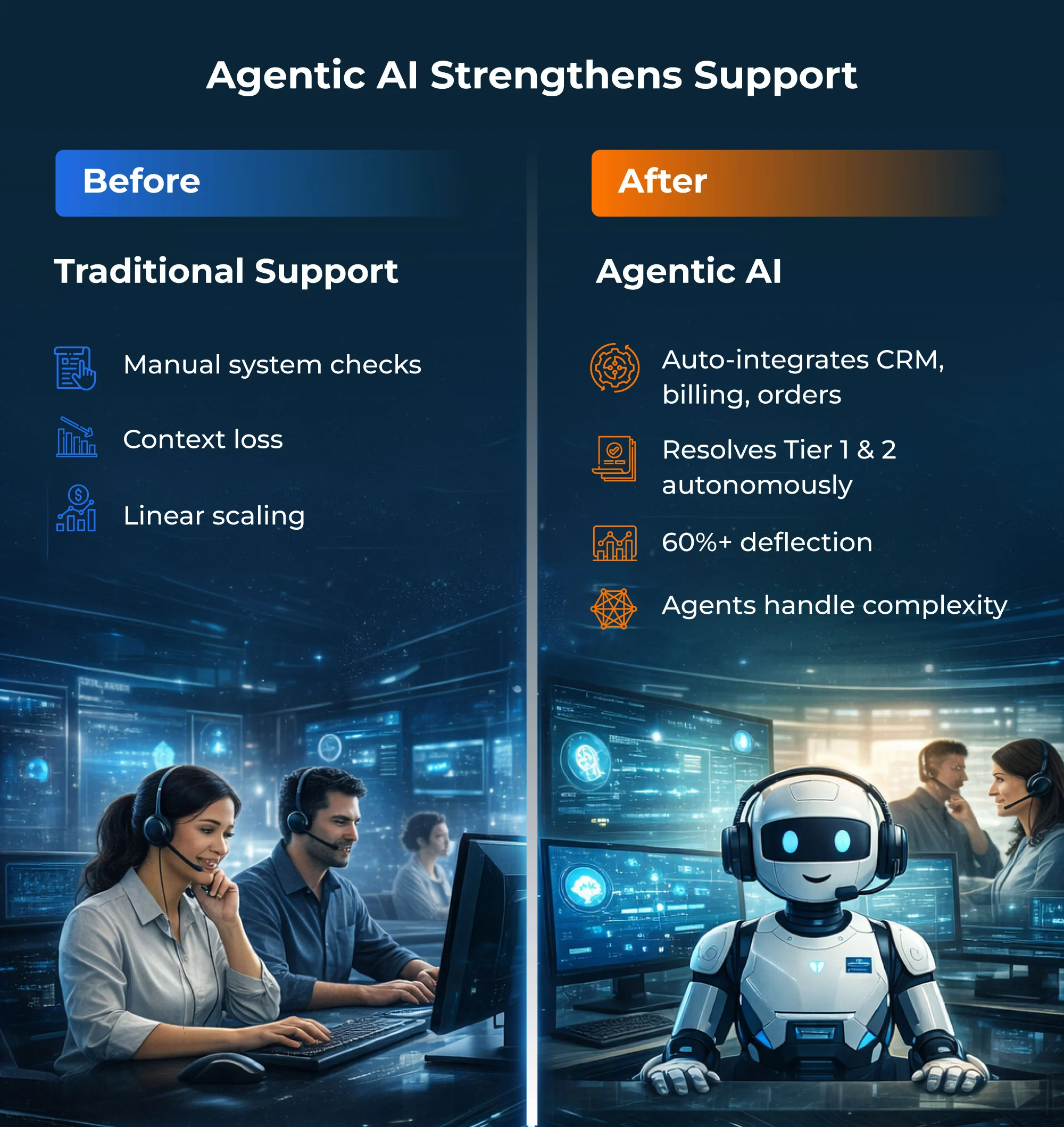
These pressures are why traditional outsourcing models are reaching their limits, and why Agentic AI changes the equation.
Customer expectations now demand faster resolution, better context, and consistent experiences across channels. Agentic AI addresses this shift by recognizing the fact that customer support is not just a conversation; it is problem-solving.
Agentic AI – the autonomous, goal-driven systems that understand intent, access enterprise context, take actions, and learn continuously. Unlike scripted automation or basic chatbots, agentic systems are designed to resolve outcomes, not deflect tickets.
For businesses operating with outsourced support, this creates a fundamental shift. Agentic AI systems directly integrate with CRMs, order management, billing platforms, identity systems, and knowledge bases. They can autonomously resolve common issues, track orders, update billing, make account changes, and complete onboarding flows. Known troubleshooting paths are also handled without human intervention.
The result is faster resolution with full context. Customers no longer need to explain their issue multiple times. The AI understands history, intent, and constraints in real time.
Brand consistency improves dramatically. Visibility becomes real-time. Leaders see why issues occur, not just how many tickets exist.
Critically, this is not about replacing humans entirely. It’s about breaking the linear relationship between headcount and support volume. Human agents, whether internal or outsourced, can thus focus on high-empathy, high-complexity cases, supported by AI rather than overwhelmed by volume.
What is the ROI of adopting Agentic AI in customer support?
The ROI case is already emerging. According to BCG, early adopters of advanced AI in customer support are targeting:
- 60%+ long-term productivity uplift
- 10-20% short-term P&L impact
- Up to 30% increase in customer lifetime value
Capgemini Research Institute estimates that Agentic AI could generate $450 billion in economic value by 2028, driven largely by operational efficiency and improved customer outcomes.
For businesses struggling with customer support outsourcing, this is not incremental optimization. It is a structural reset.
Agentic AI allows organizations to reclaim control of customer experience without rebuilding massive internal teams. It reduces cost per ticket, lowers churn, minimizes escalations, and creates a support function that scales with intelligence, not headcount.
This transition from traditional outsourcing to Agentic AI addresses operational inefficiencies and lays the foundation for intelligent, automated support. To see these capabilities in practice, companies can implement Agentic AI solutions that unify knowledge, manage routine queries, and intelligently escalate more complex issues.
From Cost Center to Competitive Advantage
Customer support outsourcing was a rational response to cost and scale pressures. But modern customer expectations have outgrown the model’s limits.
AI Agents for customer support offer a new path forward, one where service is proactive, contextual, and outcome-driven. For organizations willing to rethink how support is delivered, the opportunity is not just savings, but differentiation.
Customer support no longer needs to be a trade-off between cost and quality. With Agentic AI, it becomes a competitive advantage.
Ready to transform your customer support with Agentic AI?
Schedule a DemoFAQs
1. What are the most effective Agentic AI use cases in customer support?
Agentic AI works best for Tier 1 and Tier 2 support, such as order tracking, billing issues, account updates, onboarding, and known troubleshooting scenarios. Unlike chatbots, it can update systems, trigger workflows, and resolve issues end-to-end.
2. How does Agentic AI improve outsourced customer support efficiency?
Agentic AI reduces ticket volume, average handle time, and escalations by resolving issues autonomously. This lowers dependency on large outsourced teams and minimizes retraining costs while improving consistency and speed.
3. What should businesses look for in AI-enabled outsourcing services?
Look for deep integration with CRM and ticketing systems, real-time learning, explainable actions, strong data security, and measurable improvements in CSAT and resolution time.
4. How should vendors using autonomous AI be evaluated?
Assess whether AI resolves issues autonomously or merely deflects tickets. Prioritize vendors with proven outcomes, visibility, and clear ROI benchmarks.


