





 Last Updated: February 2, 2026
During the height of the pandemic, flight cancellations surged-and so did customer frustration. Passengers flooded social media not only because plans had collapsed, but because there was no one to talk to. Support lines were unreachable. Emails went unanswered. In their place were chatbots repeating scripted responses while money was lost and emotions ran high.
For many enterprises, this became a lasting lesson: automation that replaces access doesn’t feel like efficiency-it feels like abandonment. What customers needed wasn’t speed alone, but reassurance, judgment, and human understanding. The cost of getting this wrong is high. Research shows that in the United States, even when customers love a brand, 32% will stop doing business after just one bad experience. 59% will walk away after several unsatisfactory experiences. In Latin America, customer churn rises to 49% after a single bad experience. Hence, trust, once broken, is hard to recover.
However, today, support technology has evolved far beyond basic chatbots. Agentic AI for customer support can now resolve issues end-to-end, not just answer questions. Gartner predicts that by 2029, agentic AI will autonomously handle 80% of common customer service issues, promising unprecedented scale and efficiency.
For Heads of Customer Support, CXOs, and CIOs, adopting agentic AI can be a compelling solution. The key is deploying it thoughtfully to enhance efficiency while preserving trust, empathy, and brand voice.
Table of Content
- Why Doesn’t More AI Automatically Mean Happier Customers?
- Why Isn’t 100% Automation or 100% Human the Answer?
- How Should Enterprises Deploy Automation with Human Touch?
- How is SearchUnify Putting Human-in-the-Loop Agentic AI into Action?
Why Doesn’t More AI Automatically Mean Happier Customers?
Efficiency alone doesn’t create better experiences. In fact, over-automation often has the opposite effect.
Customers reach out when frustrated, anxious, or confused. These moments require emotional intelligence, not scripted responses. Over-automation can trap customers in chatbot loops, making it difficult to reach a human when issues are complex.
Excessive AI also flattens personalization. Algorithms can recognize patterns, but in high-trust industries like finance, healthcare, and travel, customers expect nuanced guidance. Technical limitations including misclassified queries, accent issues or irrelevant recommendations, could further erode trust.
The problem isn’t AI itself, it’s how it’s applied. The right approach balances automation with human insight, ensuring efficiency doesn’t come at the cost of empathy or relationship-building.
Why isn’t 100% Automation or 100% Human the Answer?
Despite speculation that AI would drastically reduce headcount, the reality is more measured. Gartner reports that only 20% of customer service leaders have reduced agents due to AI, showing full automation is neither practical nor sustainable.
Pure automation may speed up processes, but it struggles with judgment, nuance, and emotional intelligence. Fully human support preserves empathy, yet collapses under rising volumes, cost pressures, and agent burnout.
The answer lies in human-in-the-loop AI, where AI handles repetitive, high-volume tasks while humans remain in control of interactions that shape trust and long-term relationships. By categorizing tasks as automated, augmented, or human-led, enterprises can implement a human-first automation strategy that scales without compromising service quality.
Discover how human-in-the-loop AI balances automation and empathy.
Explore human-first agentic AIHow Should Enterprises Deploy Automation with Human Touch?
The key to human-first automation is understanding that not all customer interactions carry equal weight, and they shouldn’t all be handled the same way. Here’s a practical framework for architecting your support experience:
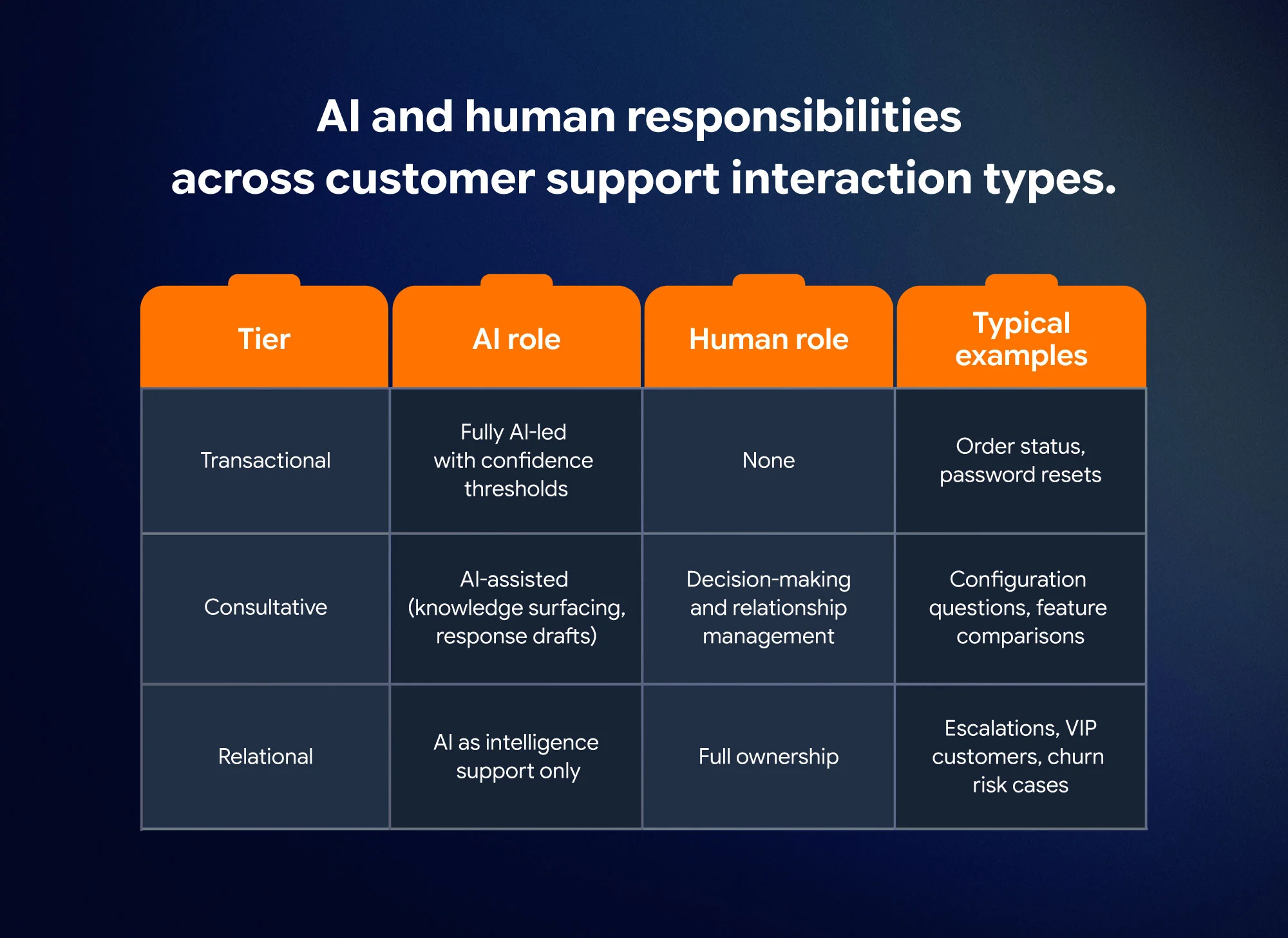
Tier 1: Transactional Interactions in Customer Support (70–80% of Volume)
These are interactions where customers want speed, not a relationship. They’re factual, repeatable, low-emotion, with objectively correct answers. Think order status checks, password resets, product specifications, return policy questions, and account balance inquiries.
This is where agentic AI should operate autonomously. Your customers don’t want to wait for a human to tell them their package is in transit. Your agents don’t want to spend their expertise on tasks that a well-designed system can resolve instantly.
AI’s role: Full autonomous resolution with confidence thresholds that trigger escalation when uncertainty arises.
Human role: None. And that’s the gift to your team. Every password reset handled by AI is time your agents can spend on problems that actually require human intelligence.
Tier 2: Consultative Interactions in Customer Support (15–25% of Volume)
These interactions require judgment, product expertise, and some degree of personalization. Configuration questions, feature comparisons, implementation guidance, workflow recommendations. There’s no single right answer. The best solution depends on the customer’s specific context.
This is where AI augmentation shines. The system surfaces relevant knowledge, drafts contextual responses, suggests solutions based on similar cases, and pulls data from multiple sources. But the human makes the final call, applies organizational context, and builds the relationship.
AI’s role: Augmentation, including surface knowledge, draft responses, and suggest solutions based on patterns.
Human role: Decision-making, context application, relationship building. The agent transforms from a typist into a problem-solver.
Tier 3: Relational Interactions in Customer Support (5–10% of Volume)
These are the moments where your brand is built or destroyed. High emotion, significant account value, trust repair, or complex judgment calls. Escalations, VIP accounts, service failures, churn risk situations, billing disputes, renewals at risk.
AI has a role here, but only as intelligence, never as an actor. The system should flag urgency based on sentiment analysis, surface complete account history and relationship context, recommend next-best-actions based on similar high-stakes resolutions, and route to the right specialist with full context.
AI’s role: Intelligence only. To provide the agent with superpowers through data, context, and recommendations.
Human role: Full ownership. This is where empathy, creative problem-solving, and brand judgment matter more than speed. This is where your competitors’ chatbots have already failed the customer.
The real danger isn’t misclassifying simple requests. It’s letting automation potentially creep into moments that demand empathy.
How is SearchUnify Putting Human-in-the-Loop Agentic AI into Action?
By embedding human checkpoints at critical points, enterprises can ensure AI amplifies capabilities without undermining trust.
SearchUnify’s approach operationalizes this balance, giving enterprises a human-first agentic AI system that handles high-volume tasks efficiently while keeping humans in control of the interactions that truly shape the customer experience.
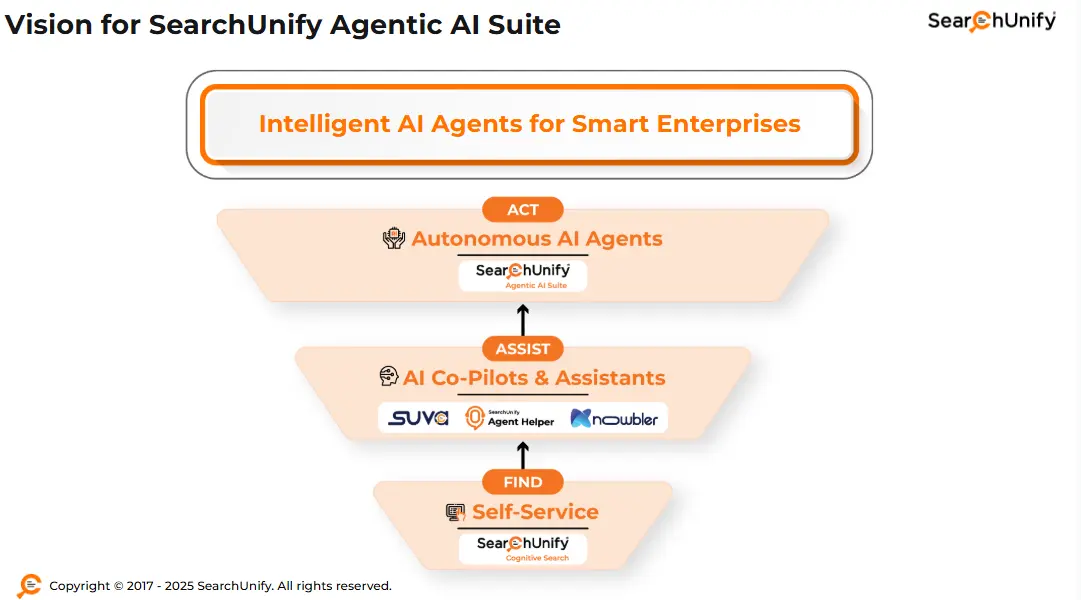
Escalation is not treated as AI failure. It is a core design principle. The SearchUnify Enterprise Agentic Platform embeds human checkpoints wherever confidence drops, ambiguity rises, or brand risk increases. This ensures automation strengthens customer experience rather than weakening it.
How can businesses balance AI and human support effectively? By adopting human-in-the-loop AI support, where automation handles routine tasks, and humans step in for complex or sensitive issues, enabling enterprise customer support automation without blocking human access.
FAQs:
1. Which sectors should exercise the greatest caution when it comes to over-automation?
Any CX automation approach must include human judgment in addition to AI in trust-sensitive industries, including healthcare, finance, insurance, and travel.
2. How can agentic AI expand customer service without negatively impacting CX?
Businesses can ensure scale without losing trust by automating high-volume processes while maintaining human control over complicated, emotional, or high-risk interactions through the use of human-in-the-loop AI support.
3. How should automation and human agents be balanced?
Based on risk, emotion, and business impact, the best CX automation approach divides interactions into three categories: AI-led, AI-assisted, and human-led.
4. How does human-in-the-loop AI reduce agent burnout?
By eliminating repetitive tasks, surfacing knowledge instantly, and reducing system switching, AI improves agent productivity while preserving meaningful, human-centric work.
5. Which CX metrics improve most with agentic AI?
Enterprises typically see gains in resolution time, first-contact resolution, agent efficiency, and customer trust without sacrificing empathy or brand voice.


