




 Last Updated: December 1, 2025
Customer support has always been an important business function. In support, the focus is on reducing resolution time, improving customer experience, and achieving a higher level of customer satisfaction. This can all only be possible with a strong escalation strategy.
Escalation management is crucial for a successful customer service strategy. It makes it easier to prioritize the ticket as per its urgency and ensures the issues are resolved on time. To manage all of the tickets manually is impossible. Fortunately, with the advent of agentic AI, this has become easier.
There are AI agents for customer service that are fully capable of managing these escalations autonomously. It interprets signals, reads customer sentiment, assesses risk, and ensures that the right agents step in at exactly the right moment with full context.
This blog dives deep into how AI-driven escalation works, the architecture behind intelligent handoffs, and the metrics support leaders should track to build a more adaptive and resilient support ecosystem.
Understanding AI Escalation: What It Really Means?
Effective contact center automation relies on an AI agent’s capability to understand when to route the case to the right agent. This is especially true in cases that involve emotions, risks, or high-value decisions.
In technical terms, AI-powered escalation is a framework where the system analyzes the conversation and determines which case is likely to get escalated.
This escalation management includes:
- Signal detection (confidence, sentiment, severity)
- Routing logic (matching agents to needs)
- Context transfer (conversation history + metadata)
- Workflow execution in the CRM or ITSM system
Without a strong escalation management strategy, contact center automation becomes unpredictable, untrustworthy, and prone to customer frustration.
The Triggers That Should Drive AI Escalation
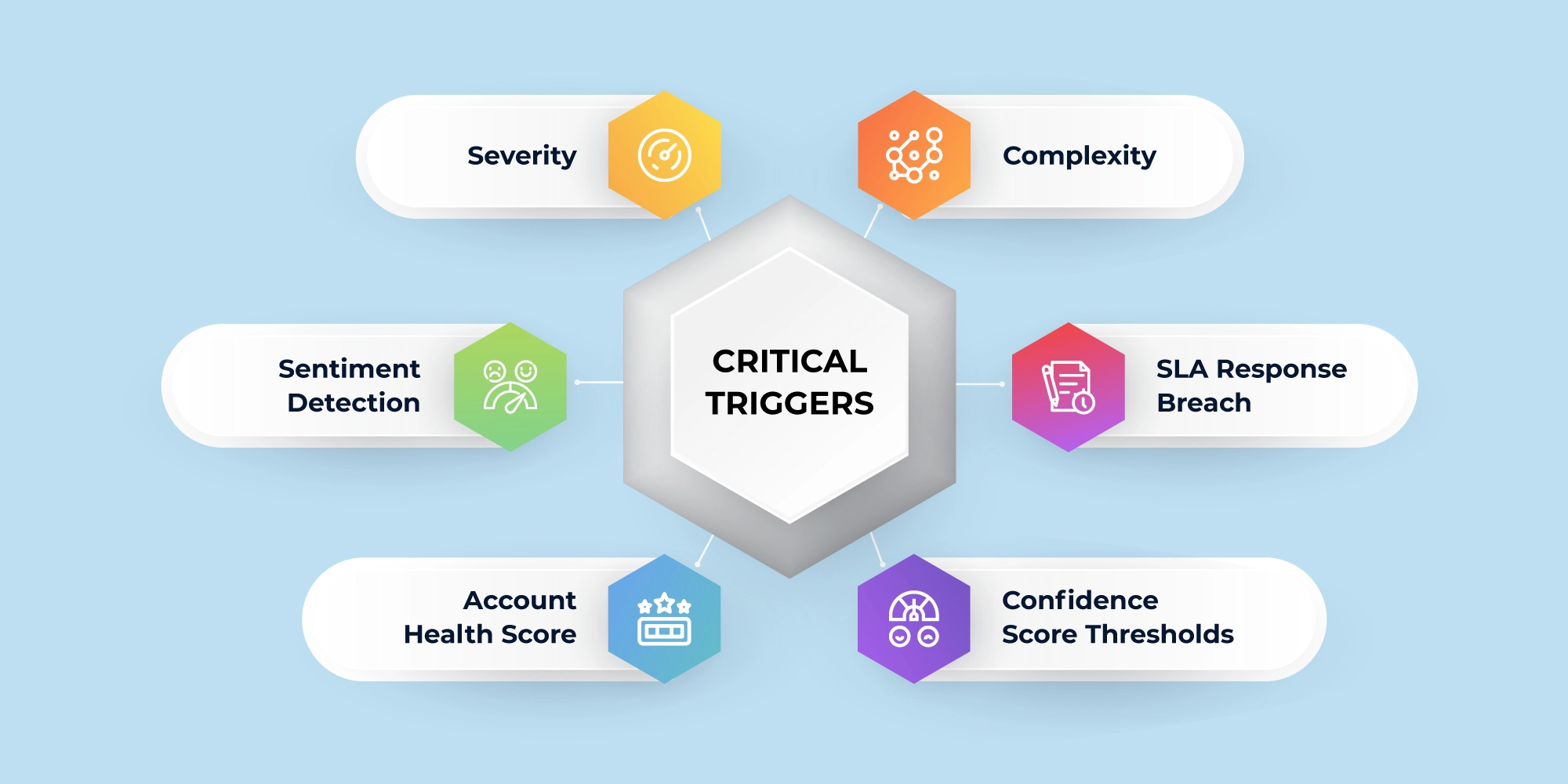
The escalation strategy should be driven by defined triggers that make the road to escalation management easier. An AI agent for escalation management requires escalation signals that consider intent, tone, account health, complexity, and operational risks. Below are the critical triggers:
1. Severity
In case the customer issue has a potential business impact, it needs to be escalated immediately. Severity-driven escalation includes cases such as:
- Platform outages or degraded performance
- Billing disputes related to overcharges or financial loss
- Security issues: account access, suspicious activity, privacy violations
- Compliance risks involving regulated industries
- System-critical bugs affecting business continuity
This AI agent detects severity by recognizing specific keywords, anomaly patterns, or matching the conversation to pre-defined high-risk intents.
2. Complexity
An AI agent for escalation management escalates complex issues that an AI support agent is unable to address. The complexity of the issues arises when:
- Multi-turn reasoning is required
- Troubleshooting involves multiple conditional steps
- Decision-making depends on contextual knowledge outside the AI’s training data
- The query spans multiple products or systems
In such scenarios, it is better to escalate the case to avoid circular loops, repeated answers, and frustrated customers. Complexity scoring ensures the AI agent escalates when reasoning becomes too deep for the model.
3. Account Health Score
Another escalation trigger is the customer account. The customer’s importance decides the case priority. This account-based escalation priority keeps the brand loyalty intact. This AI agent escalates when a customer is:
- A high-value or enterprise-tier account
- Approaching contract renewal
- Identified as churn-risk
- Holding ongoing unresolved issues
- Involved in recent escalations or complaints
It reads the account metadata in real-time and adjusts its escalation threshold. This is essential for a customer service strategy that protects revenue and retention.
4. Sentiment Detection
Sentiment is one of the most powerful escalation triggers in contact center automation. It is non-negotiable in escalation management. AI agent for escalation management escalates the case when it detects:
- Anger
- Frustration
- Confusion
- Distress
- Anxiety
- Sarcasm or negative emotional patterns
This sentiment-aware escalation strategy protects the brand reputation and provides a higher level of customer satisfaction.
5. SLA Response Breach
Support operations in businesses operate within the SLA boundaries. Delays can cause risk, irrespective of the reason. AI agent escalates when:
- SLA timers are close to breach
- A critical account waits too long
- Automation steps exceed the expected completion time
- Queue overflow conditions occur
Using SLA-driven signals ensures that automation supports operational performance.
6. Confidence Score Thresholds
This is the most traditional yet essential trigger. When the AI agent’s confidence drops below a threshold for:
- Intent classification
- Entity recognition
- Knowledge base retrieval
- Response generation
- RAG-supported relevance
It escalates immediately. Whatever the trigger, the ultimate objective of escalation management is always the same: protect the customer experience.
Architecture of a Robust AI Escalation System
A successful escalation process isn’t a simple redirect-to-agent function. It is an orchestrated multi-layer architecture involving data, AI decisioning, workflow automation, and human context transfer. Below is the blueprint support leaders should follow.
1. Detection Layer
The detection layer continuously evaluates every message for escalation triggers. This includes:
- LLM-powered intent detection
- RAG confidence levels to prevent hallucinations
- NER to identify severity patterns
- Sentiment models measuring emotional tone
- Account intelligence (health score, SLAs, history)
- Anomaly detection for unexpected patterns
- SLA timer integration for operational risk
This layer ensures that contact center automation remains reliable and customer-first.
2. Decision Layer (Escalation Engine)
This is where an AI agent for escalation management makes the real decision. It uses a hybrid approach:
- Rule-based logic for compliance, security, and severity
- ML-driven scoring models for sentiment, health, complexity, and intent drift
- Weighted scoring combining multiple signals, such as:
- Severity level
- Sentiment score
- Health score
- Confidence score
- SLA risk
- Complexity indicators
The AI agent decides whether to escalate and who to escalate to based on skills, availability, and queue conditions. This is the heart of advanced escalation management.
3. Handoff Layer
A handoff must be seamless and context-rich. When escalation is triggered:
- The full conversation history is transferred
- User profile, account metadata, CRM data, and past ticket history are included
- All attempted steps by AI are passed to the agent
- LLM-generated summaries highlight:
- Issue overview
- What the customer already tried
- Reason for escalation
- Customer sentiment level
- Recommended next steps
The agent starts fully informed not from zero. This strengthens the entire customer service strategy.
4. Feedback Loop Layer
An AI agent for escalation management is incomplete without continuous learning. It gathers the feedback that helps it to improve:
- Relevance
- Escalation scoring thresholds
- Knowledge quality
- AI reasoning
- Mapping of severity or complexity patterns
A self-learning loop ensures that AI-powered escalation becomes smarter over time.
Designing Seamless Human Handoffs: Best Practices
Implementing an escalation workflow is not enough. It must be excellent. Below are best practices that elevate your entire support operation.
1. Preserve Context Integrity
The AI agent for escalation management should pasthe s complete context, including:
- Chat transcript
- Intent confidence
- Relevant articles used by the AI
- Conversation sentiment score
- Account health information
- Reason for escalation
- SLA status
Agents must not lose time recreating context. Smooth context transfer is the foundation of intelligent contact center automation.
2. Provide Human-Readable Summaries
Agents waste time when they have to scroll through long conversations. AI escalation should fill in the details related to:
- Customer’s issue
- What solution was offered?
- Why the escalation was triggered (severity, sentiment, SLA risk, etc.)
- Customer mood
- Recommended action steps
This gives a kick start to the agent in resolving the issue.
3. Ensure Omni-Channel Consistency
Whether the customer contacts support through chat, email, voice, or portals, the escalation flow must remain unified. Consistency across channels is essential to an enterprise-grade customer service strategy.
Metrics That Define AI Escalation Success
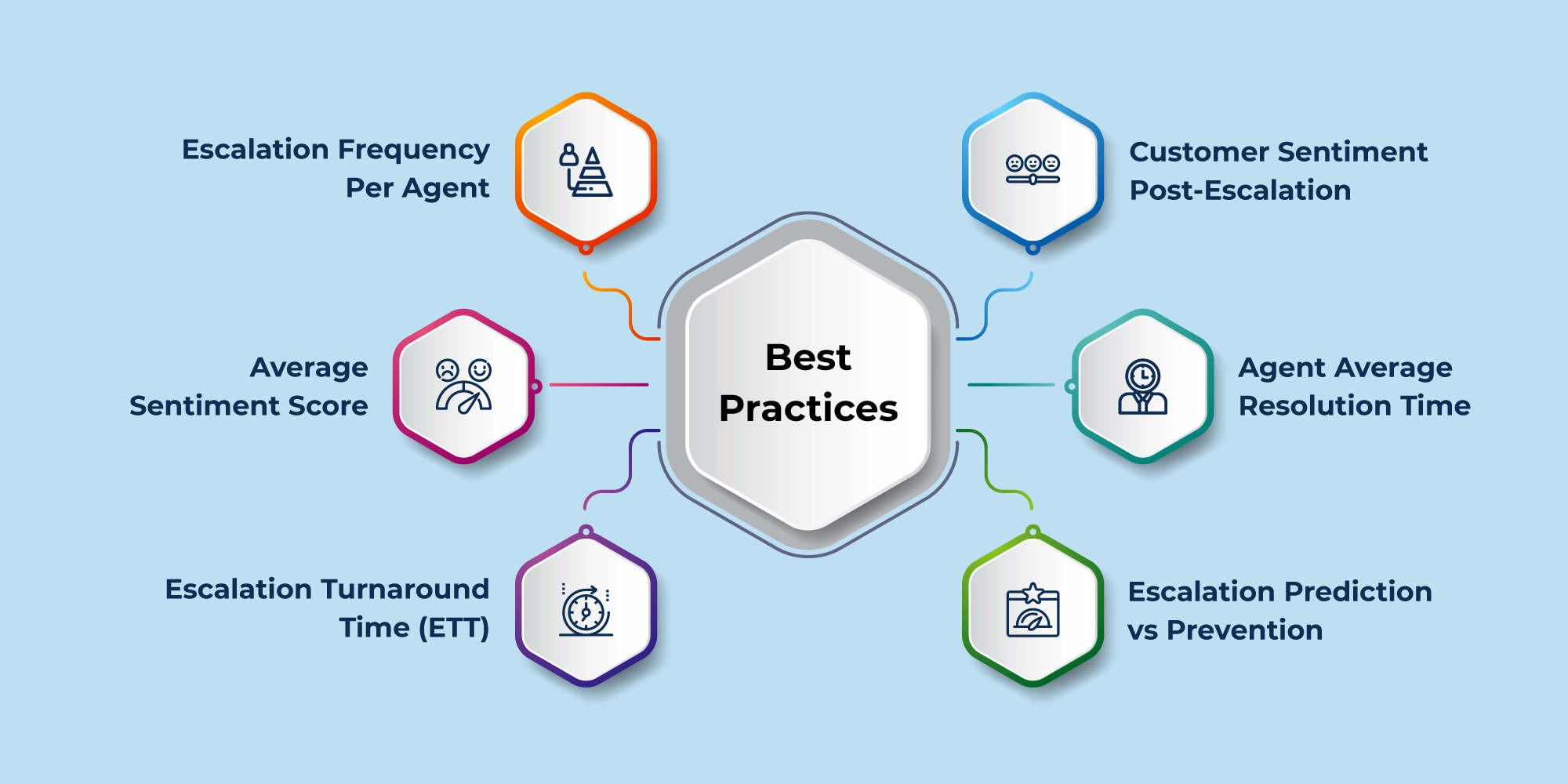
Support leaders must quantify the performance of their AI agents for escalation management by measuring the metrics, including:
1. Escalation Frequency Per Agent
If some agents receive more escalations than others, routing logic may be misaligned, or the model might be too restrictive with certain intents.
2. Customer Sentiment Post-Escalation
This measures emotional recovery after the takeover. A well-handled escalation typically shows a positive sentiment shift.
3. Average Sentiment Score
Tracking sentiment across all escalated interactions helps identify:
- Patterns of frustration
- Systemic issues
- Opportunities for AI improvement
Sentiment is one of the strongest indicators for evaluating contact center automation impact.
4. Agent Average Resolution Time
Smart escalation should reduce agent handling time. If resolution time rises, it indicates a delay in escalations.
5. Escalation Turnaround Time (ETT)
Measures how long it takes from:
Escalation trigger → Agent pickup → Agent’s first meaningful response
A high ETT indicates friction in the escalation pipeline.
6. Escalation Prediction vs Prevention
Advanced systems track:
- How well the AI agent predicts when an escalation is needed
- How many escalations were prevented by proactive guidance, clarification prompts, or sentiment restoration
High prediction accuracy reflects a mature customer service strategy backed by intelligent automation.
Conclusion
The future of support is bright, and with a strong AI escalation strategy, it can change into a powerful experience enabler.
For support leaders, the message is clear: automation is only as strong as its escalation. When escalation management is architected thoughtfully, customers feel supported, agents feel empowered, and the organization builds trust with every interaction.
So, are you ready to redefine your escalation management?
If yes, connect with our experts today to embrace a strong escalation strategy.


