





 Last Updated: February 19, 2026
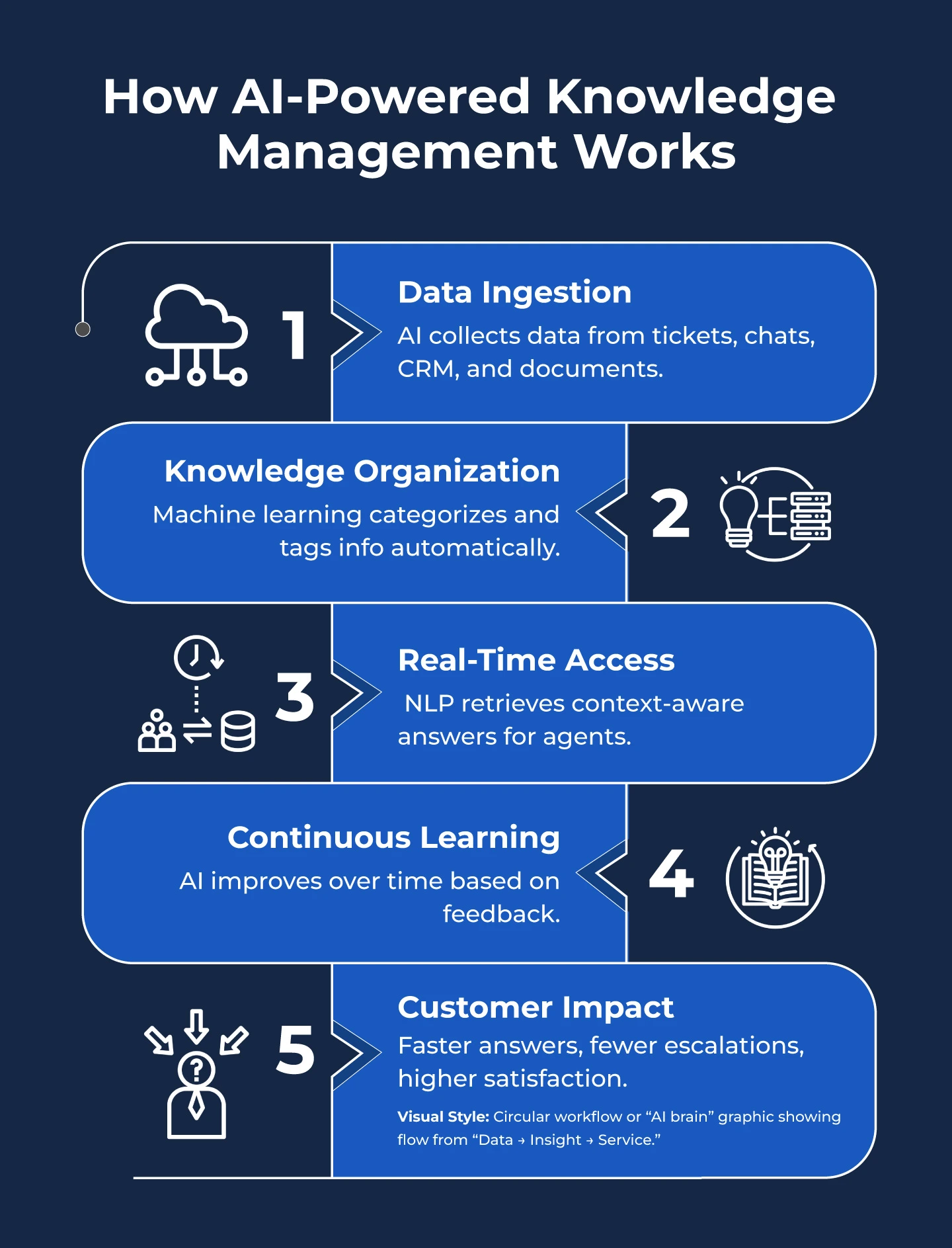
AI-powered knowledge management is used by organizations to automatically store, arrange, and distribute important data as needed. These include corporate guidelines and other types of institutional knowledge found throughout your corporation. AI facilitates the automation of data gathering and classification. Consequently, your customer service staff will have immediate access to information. Agents provide quicker, more individualized service when they are able to locate precise responses.
Customers today have higher expectations. Customer service representatives are under tremendous strain. According to a State of Service report by Salesforce, 69% of CSRs find it difficult to strike a balance between speed and quality, and 82% of them claim that customer expectations have increased. They spend a significant portion of their time searching for solutions to consumer questions. This is a result of the majority of company data being dispersed or isolated. A decrease in customer satisfaction and eventually customer churn might result from a delay in resolving customer problems.
AI-powered knowledge management helps in this situation. It provides service representatives with the most up-to-date and pertinent information, enabling them to confidently handle problems and satisfy growing client requests.
The value goes far beyond better service. McKinsey estimates that AI use cases in knowledge workflows could unlock $4.4 trillion in global productivity gains. This finding validates what forward-looking organizations are already experiencing: AI-powered knowledge management systems drive faster operations, lower costs, and smarter decision-making.
The business case is clear and proven. Companies adopting AI-KM see measurable ROI within months, not years. Yet, as results become more visible, leaders are asking deeper questions: How do we quantify this transformation? What’s the true financial impact of applying AI to enterprise knowledge?
This guide explores those answers. You will discover what Agentic AI powered knowledge management automation is, how it functions, and why it is now required. More significantly, you’ll see how it’s changing customer service by transforming information into an intelligent asset that speeds up expansion, innovation, and client retention.
What is AI Knowledge Management?
AI in knowledge management helps companies store, find, and share information more efficiently.
It uses tools like natural language processing and machine learning to understand and organize large amounts of data, past interactions, and company policies.
This makes information easy to find for customer service teams. As a result, they can quickly give customers accurate and personalized answers.
AI Knowledge Management uses Artificial intelligence to retrieve, share and store a company’s collective knowledge effectively.
Why is Knowledge Management crucial for your business?
Knowledge management helps store and share company policies and best practices in one place. It offers service representatives access to the most recent information and helps them adhere to the most recent regulations.
Additionally, Knowledge management links to various systems and papers, providing teams with additional context to help them make better decisions. Agents receive all the information they require to resolve situations more quickly. It gets even more potent when AI is included. AI helps service representatives address problems more quickly by providing them with up-to-date, correct information. Teams can use generative AI to integrate fresh information from outside sources with what they already know.
For customers, this means faster, more accurate, and more helpful responses.
The Case for AI-Powered Knowledge Management
In every large organization, knowledge is abundant yet rarely accessible when it’s needed most. Over time, this scattered and outdated information builds up as knowledge debt. This silently drains productivity, efficiency, and customer experience.
Consider the daily struggle of a support agent. They spend most of their time hunting for answers across systems, knowledge bases, and chat logs. This time could have gone into resolving issues or delighting customers. The ripple effects are longer handle times, inconsistent responses, and frustrated teams. For CX leaders, the stakes are even higher. For every 1% improvement in FCR, customer satisfaction improves by 1%.
Meanwhile, knowledge managers are overwhelmed trying to manually update thousands of documents and policies. The pace of change, new products, regulations, and channels, makes traditional KM unsustainable.
This is where AI-powered Knowledge Management changes the story. AI organizes information. It learns, curates, and delivers the right insight in real time. It turns static knowledge into a dynamic, intelligent ecosystem that empowers every employee and elevates every customer interaction.
What is the potential ROI of AI in Knowledge Management?
AI in knowledge management delivers clear, measurable returns. Research and enterprise data show consistent financial and operational benefits across industries.
1. Strong financial returns
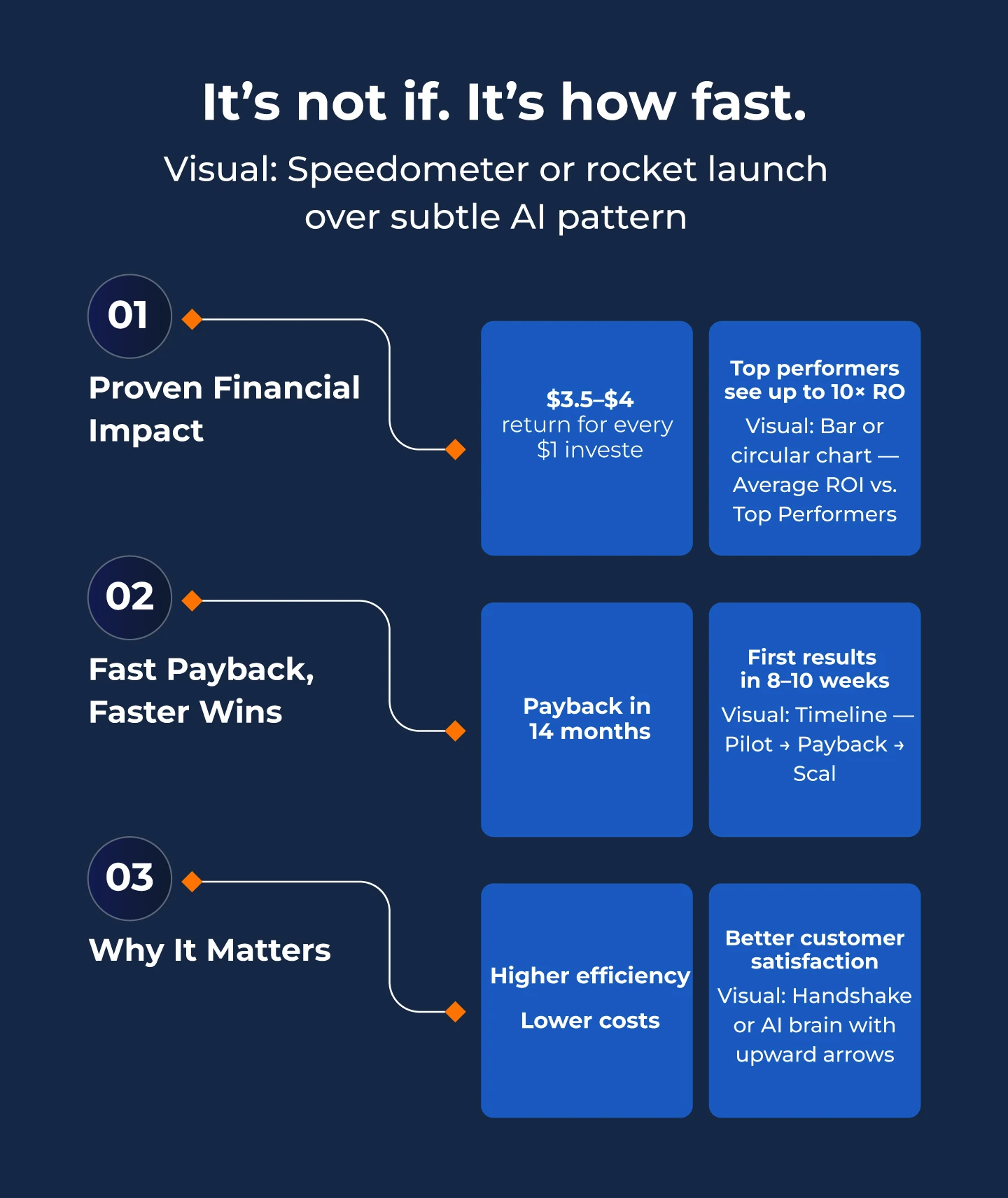
According to IDC, organizations see an average of 3.5X ROI for investments in AI-based knowledge systems. Mature adopters using generative AI in customer support or operations have reported up to 10× ROI, according to studies by IDC and Deloitte.
2. Faster time to value
AI-KM systems move fast. On average, AI deployments are taking less than 8 months to deploy, and organizations are realizing the value in less than 13 months.
Unlike traditional IT projects that take years, these solutions can be prototyped, tested, and scaled within weeks. Over 90% of companies report positive returns in the first year, making it one of the fastest-paying enterprise investments.
3. Reclaimed human capacity
AI automates repetitive work like document drafting, data tagging, and report generation. Employees can then focus on creative and strategic tasks.
4. Lower risk, higher agility
AI-KM tools are modular and easy to deploy. Companies can start small, often as pilots within existing systems, and scale once results appear. Even limited rollouts deliver efficiency gains within weeks.
How to Build a Business Case for Knowledge Management AI?
Establish specific goals first. Describe the goals of AI knowledge management (KM), such as quicker responses, reduced expenses, or better choices. Connect these objectives to the strategy of your company. As a result, AI KM becomes a business enabler rather than just a technological advancement. Demonstrate how it can address actual issues, such as lost time looking for information or sluggish content updates, and tie this to quantifiable results.
Step 1: Comply with Business Goals
Link the results of AI Knowledge Management automation to the following top priorities: cost reduction, staff productivity, customer experience, and digital transformation. For instance, quicker access to information increases NPS and enhances first-contact resolution. Demonstrate to leaders how AI KM helps all departments accomplish their objectives.
Step 2: Benchmark Current Performance
Before putting AI into practice, assess your current situation. Monitor measures such as ticket deflection, average handling time (AHT), CSAT, and information search time. You can later quantify impact using these baselines.
Step 3: Build a Pilot ROI Model
Start by quantifying tangible outcomes such as reduced agent effort or faster issue resolution. Research shows that employees spend nearly 20% of their time searching for information. Even cutting that time by 30% can unlock significant productivity gains. When you scale these small improvements across teams and regions, the cumulative impact on efficiency and ROI becomes undeniable.
Step 4: Secure Cross-Functional Buy-In
Knowledge Management is not limited to support teams. Bring leaders from operations, IT, KM, and CX to the table. A portion of the knowledge ecosystem belongs to each team. Aligning investments and adoption is facilitated by a common vision.
Step 5: Present a Roadmap for Scale
Once the pilot succeeds, map how AI KM can expand enterprise-wide. Describe how it serves a variety of purposes by integrating with current tools, such as CRM, service platforms, and analytics. Emphasize the advantages of governance, scalability, and compliance.
Ready to accelerate your ROI with AI-powered Knowledge Management?
Let’s ConnectHow Knowledge Management AI Is Transforming Businesses?
Knowledge Management AI is transforming how businesses operate, and the numbers tell a compelling story. The Global AI-driven Knowledge Management Systems Market is on a high growth trajectory. The market is expected to skyrocket from $3.0 billion in 2024 to $102.1 billion by 2034.
The business case is undeniable. Reports suggest that organizations with well-structured knowledge management practices see a 15% to 30% boost in productivity. That’s the kind of impact that shows up on the bottom line and gets noticed in boardrooms.
At the same time, customer satisfaction scores increase by 15%, directly translating into stronger loyalty and repeat business. In today’s hyper-competitive marketplace, such customer retention can make or break a company.
Employee engagement also rises by 20% when knowledge-sharing cultures take root, leading to better retention and workplace morale.
But here’s the sobering reality: poor knowledge management costs companies an average of $420,000 annually through flawed decision-making. That’s nearly half a million dollars walking out the door simply because the right information didn’t reach the right people at the right time.
The Strategic Edge: What AI Actually Delivers
When AI enters the equation, the transformation becomes tangible. According to a comprehensive APQC survey on emerging technologies in knowledge management, organizations report robust outcomes:
- 41% see reduced redundant and siloed work,
- 37% experience streamlined processes,
- 30% make better decisions, and
- 29% achieve improved taxonomy and content management alongside enhanced information quality.
These represent a fundamental shift in how organizations leverage their collective intelligence.
As we move beyond 2025, businesses that harness Knowledge Management AI will find themselves with an edge that’s increasingly difficult for competitors to match.
Ready to Bring AI-Powered Knowledge Management to Your Organization?
If you’re looking to transform how your teams access and apply knowledge, SearchUnify’s AI Knowledge Agent is a powerful place to start.
The AI Knowledge Agent equips your support teams and customers with intelligent, real-time insights. It automatically surfaces the most relevant articles, past case data, and recommended solutions right within the support workflow. This reduces manual effort, accelerates resolution times, and boosts agent confidence.
For Heads of Customer Support, that means fewer escalations and faster case closures. For VPs of Customer Experience, it delivers smoother, more personalized interactions that lift CSAT and strengthen loyalty. For CIOs, it provides scalable, secure integration across systems, turning knowledge into a true enterprise asset.
By reducing wait times and ensuring every response is accurate, AI-powered Knowledge Management enables a proactive, adaptive customer service model.
Why AI-Powered Knowledge Management Is a Strategic Imperative?
AI-powered knowledge management is a competitive necessity today.
AI ensures every agent and every customer gets the right answer at the right time. The result is measurable: faster case resolution, higher first-contact resolution rates, and happier customers.
But the strategic value runs deeper. AI-driven KM scales expertise across your enterprise. It captures and shares institutional intelligence that would otherwise be lost to turnover or data sprawl. It helps your organization learn faster, adapt faster, and make smarter decisions. And in an age of constant disruption, adaptability is the new moat.
Business leaders must stop viewing AI knowledge management as a “nice-to-have.” It’s the foundation for operational resilience and customer trust. Start small, identify your highest-impact use case, pilot AI in a single workflow, and measure the lift. Every minute you wait, your competitors’ AI systems are getting smarter.
It’s time to put your enterprise knowledge to work. The organizations that master AI in knowledge management today will define customer experience tomorrow.
Ready to see the impact firsthand? Reach out to SearchUnify and discover how the AI Knowledge Agent can transform your support ecosystem.
FAQ
1. What are the key features of AI Knowledge Management?
- Automated knowledge creation
- Smart search
- Personalized recommendations
- Natural language understanding
- Continuous learning
2. How does AI transform traditional knowledge management?
By converting manual, static systems into intelligent, adaptive ones, artificial intelligence (AI) reinvents traditional knowledge management. It provides quicker, more precise responses in real time by utilizing natural language processing, customization, and ongoing learning.
3. Can AI-powered knowledge management enhance customer service?
Yes. Knowledge management AI enhances customer service by giving agents instant access to accurate, relevant information. It powers AI-driven self-service options and ensures customers get consistent, up-to-date answers across every channel. Thus improving both speed and satisfaction.


