





 Last Updated: February 17, 2026
“The future of enterprise success lies in adopting AI systems that think, act, and evolve—hallmarks of Agentic AI.”
— Michael Tanaka, CTO, AI Innovations Inc.
Nearly three decades ago, in his book The Road Ahead, Bill Gates envisioned a world where intelligent software agents would fundamentally change how we live and work. Fast forward to today, his predictions have become our reality.
This isn’t just about technology—this is about a paradigm shift that holds immense business value, particularly for the C-suite.
Let’s dive into how this groundbreaking technology can drive innovation and efficiency, helping leaders like you stay ahead in an AI-driven world.
What is Agentic AI?
Think of a world where artificial intelligence doesn’t just respond to questions but actively solve problems, makes decisions, and adapts in real-time. That’s what agentic AI promises which is the next leap forward in intelligent systems.
For instance, think about an AI agent in customer service. Instead of just answering a question like “What’s my account balance?” an agentic AI could gather information from various sources, suggest potential solutions (like recommending which accounts could pay off an outstanding balance), and wait for the user’s input to finalize the transaction seamlessly.
These systems ingest vast amounts of data from multiple sources, including third-party applications, to independently analyze challenges and execute tasks. This autonomous capability allows businesses to streamline processes, personalize services, and enhance operational efficiency. From improving customer support experiences to accelerating software development and even enhancing healthcare interactions, agentic AI is poised to revolutionize how we interact with technology.
Why Agentic AI?
Today, the world demands proactive intelligence. Enterprises are increasingly navigating between dynamic and complex business landscapes. Agentic AI addresses modern challenges like:
- Operational Complexity: Enterprises today operate in fast-paced environments with dynamic demands. Agentic AI simplifies operations by automating workflows and offering real-time adaptability.
- Data Overload: With enterprises generating terabytes of data daily, Agentic AI helps make sense of this data, extracting actionable insights to inform strategies.
- Customer Expectations: Customers demand faster, personalized experiences. Agentic AI agents proactively anticipate and meet these needs, enhancing satisfaction and loyalty.
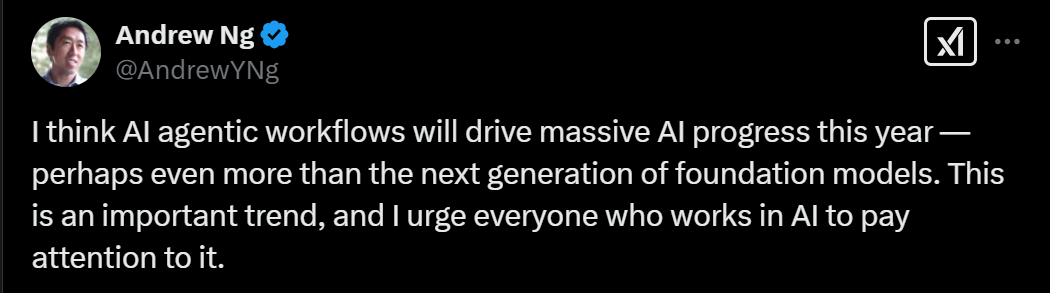
In a podcast episode, Aidan Toner-Rodgers, a Ph.D. student at MIT, discusses how AI integration in research and development labs has led to a 44% increase in material discoveries and a 39% rise in patent filings, highlighting AI’s role in boosting productivity.
Sounds interesting, right?
Now, let’s dive into its workings and functionalities.
How Does Agentic AI Work?
Agentic AI goes beyond traditional AI by autonomously making decisions, setting goals, and continuously learning. Instead of passively responding to queries, it actively understands its environment, formulates strategies, and takes action.
It operates through four key components: Perception Modules (processing sensory data like text and images), Reasoning Engines (analyzing data to make informed decisions), Actuation Frameworks (executing decisions autonomously), and Feedback Mechanisms (learning from real-world outcomes). Imagine it as a self-sufficient assistant—gathering data, setting objectives, planning actions, executing tasks, and refining its approach based on feedback. Whether it’s a robotic vacuum optimizing its cleaning route or an AI-powered support agent resolving queries, Agentic AI adapts and evolves, making it a game-changer for intelligent automation.
As said by Demis Hassabis, CEO and Co-founder of DeepMind, “Agentic AI is not just about processing information, but about reasoning, planning, and executing actions in the real world, much like a human agent.“
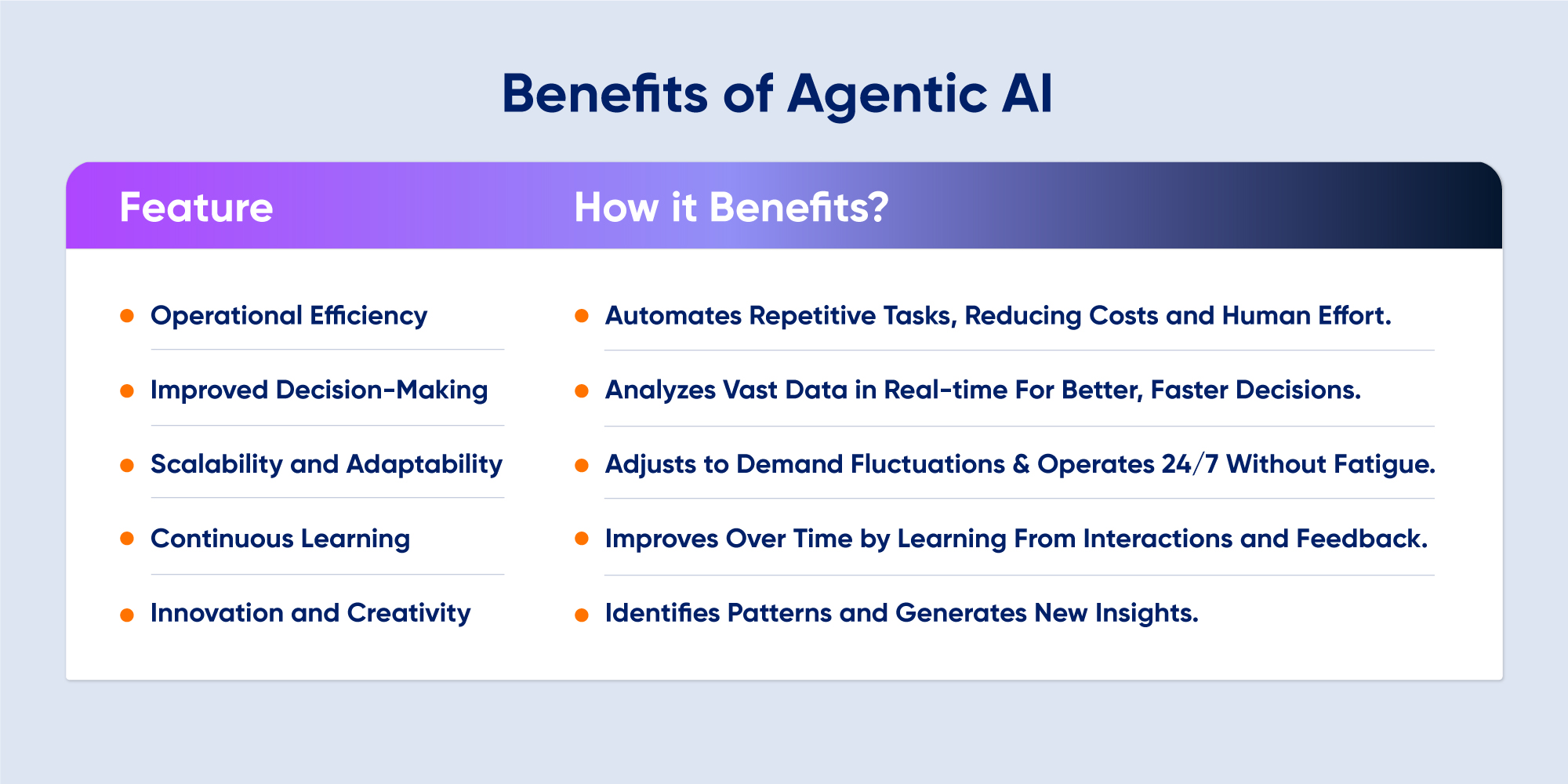
After understanding the key functionalities and core components, let’s explore the advantages of Agentic AI.
Benefits of Agentic AI
Agentic AI Use Cases
Here’s an overview of its application across different industries:
Customer Service Industry
Agentic AI in customer service provides real-time assistance to customers, resolving queries without human intervention. Gartner predicts that by 2025, AI will handle 80% of customer interactions, improving response times and customer satisfaction.
High-Tech Industry
Agentic AI automates IT support and assists in resolving technical issues instantly. As per Forrester, AI-driven IT support reduces downtime up to 40%, boosting productivity and efficiency.
Healthcare Industry
A study by Accenture estimates that AI applications could save the U.S. healthcare economy up to $150 billion annually by 2026. Agentic AI analyzes patient data and helps in providing more precise and personalized treatments.
Pharmaceuticals & Life Sciences
According to McKinsey, AI-driven drug discovery could cut R&D costs by 50%, leading to faster and more cost-effective treatments. Agentic AI accelerates drug discovery, enhances clinical trials, and automates complex R&D and regulatory workflows.
Finance Industry
A report by BCG suggests that 75% of finance leaders expect agentic AI to become routine by 2028. Agentic AI in the finance industry autonomously handles complex tasks such as fraud detection, credit decisions, risk management, customer service, and more.
Retail Industry
Agentic AI optimizes stock levels by predicting demand and automating restocking processes in the retail industry. As per McKinsey reports, AI-driven inventory management can reduce stock errors by up to 50% and increase sales by 2-3%.
Learning & Training
Agentic AI revolutionizes corporate training by delivering personalized learning paths, automating assessments, and providing real-time coaching. A LinkedIn Learning report found that 94% of employees prefer AI-enhanced learning due to its flexibility and relevance.
Manufacturing Industry
Agentic AI anticipates equipment failures and schedules maintenance to prevent downtime. Moreover, the International Society of Automation estimates that predictive maintenance can lead to a 30% reduction in maintenance costs and a 70% decrease in breakdowns, resulting in higher productivity.
Unlock the full potential of Agentic AI for your business.
Let’s TalkAgentic AI in Customer Service & Its Future Scope
Agentic AI is rapidly transforming how different industries operate. However, the customer service domain is hugely impacted by this technological shift. As support functions evolve beyond traditional, reactive models, enterprises are rethinking how they engage, assist, and retain customers.
As customer service is shifting from reactive ticket handling to proactive, autonomous experience, customers seek instant resolutions, personalized interactions, and consistent support across multiple channels. Agentic AI is at the core of this transformation, enabling systems to understand context, take independent actions, and continuously learn from interactions.
By proactively resolving issues and optimizing support workflows in real time, Agentic AI in customer service helps businesses deliver consistent, high-quality experiences at scale. In a landscape shaped by rising expectations and digital-first customers, organizations can no longer afford to compromise on speed, personalization, or service excellence.
The Future Scope
The shift toward proactive, autonomous customer support isn’t just hype, it’s backed by major industry forecasts and adoption data:
- According to Cisco, the agentic AI will handle up to 68% of customer service and support interaction by 2028, driven by demand for more personalized, proactive, and predictive experiences.
- By the end of 2026, AI is expected to handle 95% of all customer interactions, across both voice and text.
- The market for AI-powered support solutions is anticipated to skyrocket from $12.06B to $47.82B by 2030, growing at 25.8% CAGR (in the forecast period 2024-30).
- According to Gartner, by 2029 agentic AI in customer service will autonomously resolve about 80% common service issues without human involvement.
- A report states that 95% of customer interactions will involve AI by 2025, spanning basic inquiries to advanced automated workflows.
- Around 80–95% of companies are already using or planning to use AI tools (like chatbots and virtual assistants) for customer service by 2025, signaling near-mainstream integration.
- According to Tidio, 95% of customer interactions will involve AI by 2025.
Difference Between Traditional, Generative AI, and Agentic AI
Outlining the progression from task-oriented Traditional AI to the creative capabilities of Generative AI, and finally, to the proactive intelligence and autonomy of Agentic AI, showcasing how each stage advances business capabilities.
| Aspect | Traditional AI | Generative AI | Agentic AI |
| Definition | AI systems are designed to perform specific tasks based on pre-defined algorithms and training data. | AI that creates new content, such as text, images, or videos, based on patterns learned from large datasets. | Advanced AI that combines autonomy, adaptability, and decision-making to proactively execute tasks and strategies. |
| Scope | Narrow focus, addressing single-purpose applications (e.g., fraud detection, image recognition). | Creative and exploratory applications (e.g., generating marketing copy, designing new products). | Broad applications require multi-tasking, integration with various systems, and strategic decision-making. |
| Examples | Chatbots programmed for FAQs, spam filters, and recommendation engines (e.g., Netflix recommendations). | GPT-based chat tools, AI art generators (e.g., DALL-E), code generation platforms. | Intelligent systems managing supply chain operations, automating proactive customer support, or workflow optimization. |
| Use Cases in Customer Support | Automated ticket categorization, and FAQ bots. | Creating dynamic responses, and summarizing customer sentiment. | Proactively suggesting solutions, optimizing ticket routing, and learning from customer interactions to refine processes. |
| Impact on Business | Improves efficiency in routine processes and reduces operational costs. | Enhances creativity and innovation by providing diverse ideas or content. | Drives strategic growth by optimizing decision-making, improving agility, and enabling proactive operations. |
| Flexibility | Low flexibility; not designed to adapt beyond predefined parameters. | Moderate flexibility; adapts to generate creative outputs based on varied prompts. | High flexibility; dynamically adjusts actions and strategies based on environmental and operational changes. |
| Human Dependency | Requires significant human oversight for training, maintenance, and updates. | Requires human validation for generated outputs and training on specific tasks. | Operates with minimal human input, taking responsibility for execution and feedback loops. |
| Interaction with Data | Processes structured and semi-structured data. | Learns from and generates outputs based on unstructured data like text, images, or audio. | Processes and synthesizes structured, semi-structured, and unstructured data in real time. |
| Learning Capability | Limited to pre-defined training data and requires periodic retraining for new tasks. | Learns from vast datasets but generally doesn’t adapt after deployment without additional training. | Continuously learns and adapts in real time based on new inputs and evolving contexts. |
Now that we know the difference clearly, let’s understand why Agentic AI is the talk of the town.
How Did We Arrive At This Agentic Milestone?
It all started with simple chatbots—early digital assistants that followed rigid scripts, responding only when a query matched a predefined pattern. They were groundbreaking but limited, unable to understand nuances, adapt to unexpected questions, or truly “think” beyond their programmed rules.
Yet, these early systems proved one thing: AI could bridge the gap between machines and human conversations. As businesses demanded smarter, more autonomous solutions, AI evolved. Advances in natural language understanding, contextual awareness, and real-time learning led to the rise of Agentic AI—systems that don’t just respond but anticipate, adapt, and act independently.
From passive responders to proactive problem-solvers, AI has come a long way—and Agentic AI is just getting started.
Risk and Challenges
While Agentic AI is known for autonomous decision making and efficiency, it also has a few risks that enterprises must navigate. Data privacy and security remain top concerns, as autonomous AI systems process vast amounts of sensitive information, increasing exposure to breaches. Bias and ethical concerns can emerge if AI models inherit or amplify existing biases in training data, leading to flawed decision-making, as seen in AI-driven hiring tools.
Lack of explainability poses another challenge—AI systems often operate as “black boxes,” making it difficult to audit decisions, a major issue in regulated industries like finance and healthcare.
Concluding Thoughts
With agentic AI’s potential to think, act, and learn autonomously, it empowers organizations to stay proactive in a rapidly evolving landscape, it’s named beyond a technological advancement.
Imagine delivering hyper-personalized customer experiences, streamlining operations, and scaling your business effortlessly while staying ahead of the competition. That’s the promise of Agentic AI.
Now it’s your turn. Take the first step toward revolutionizing your enterprise operations.
Frequently Asked Questions
1. What’s the impact of agentic AI on customer experience?
It automates resolutions, personalizes interactions, and reduces response times, freeing human agents for complex issues.
2. What is the difference between generative AI and agentic AI?
Generative AI creates content, while Agentic AI makes decisions, takes actions, and learns from interactions.
3. What is the difference between agentic AI and AI agents?
Agentic AI is a broad system that autonomously learns and acts, while AI agents are task-specific, like chatbots or virtual assistants.
4. How does Agentic AI differ from traditional AI?
Traditional AI follows rules and reacts passively, whereas Agentic AI operates independently, making proactive decisions and learning continuously.
5. What are the key features of Agentic AI?
Autonomy, contextual awareness, adaptability, and multi-step problem-solving.
6. Can Agentic AI learn from interactions?
Yes, it continuously learns and improves its performance over time.
7. What technologies power Agentic AI?
Machine learning, natural language processing (NLP), and large language models (LLMs).
8. What are some examples of Agentic AI?
Autonomous vehicles, smart assistants, robotic process automation.
9. What is the future potential of Agentic AI?
Increased sophistication in decision-making capabilities and broader applications across industries.
10. What are the long-term goals for developing agentic AI?
Agentic AI will evolve to be fully autonomous, self-optimizing, and capable of creating and executing workflows dynamically, driving the autonomous enterprise forward.
11. What Makes Up Agentic AI?
Perception + Planning + Action + Learning = Autonomous Decision-Making
12. How do we regulate agentic AI?
Regulating agentic AI involves establishing ethical guidelines, implementing robust oversight mechanisms, and fostering international cooperation to ensure AI systems align with human values and safety standards.
13. How to build an AI agent (lifecycle)?
Building an AI agent involves defining objectives, designing architecture, developing and training models, rigorous testing, and continuous monitoring to ensure performance and adaptability.
14. What are the components of an AI agent stack (architecture)?
An AI agent’s architecture includes perception modules for data collection, decision-making algorithms, action mechanisms for task execution, and learning components for continuous improvement.
15. How do we ensure agentic AI aligns with human values?
Ensuring agentic AI aligns with human values requires integrating ethical considerations during development, continuous monitoring, and updating AI behaviors to reflect societal norms and prevent misalignment.
16. What is Agentic AI in customer service?
It refers to an intelligent system that autonomously understands customer intent, makes decisions, and takes actions to resolve issues. Unlike traditional chatbots, Agentic AI goes beyond simply answering questions.
17. What is the future of agentic AI in customer service?
Agentic AI will redefine service operations by improving speed, consistency, and customer experience while reducing operational costs. Moreover, it will enable autonomous, proactive support by resolving issues end-to-end and personalizing interactions at scale. According to McKinsey, 81% of consumers expect companies to deliver personalized interactions.


