




 Last Updated: February 4, 2026
CX is a pivotal differentiator for support.
However, for enterprises still relying on manual QA for support, just 10–12% of closed cases make it to the audit phase The remaining vanish into the operational ether, taking with them critical insight about agent performance, compliance risk, and customer sentiment.
That tiny sample is a massive missed opportunity to improve case prevention, case closure rates, CSAT, and support ROI. For enterprise support leaders, that is an uncomfortable reality. You are making million-dollar decisions about training, staffing, and strategy based on a statistically insignificant sample. According to Gartner, 82 percent of customers remain with a company when their support interactions include value enhancement.
How can you consistently deliver value when you are effectively blind across the vast majority of customer conversations? The state of AI in 2026, promises to flip the script. With AI Agents for customer service, the way enterprises orchestrated support, changes fundamentally. And a key part of this Agentic AI powered support orchestration is automated support QA.
The Hidden Cost of Manual Support QA
Beyond numbers, the risks of incomplete and inadequate audits are more direct than they may seem at first. When errors in sentiment, compliance, or resolution accuracy slip through the cracks, resulting in the following fundamental constraints:
Coverage and Scalability. A single analyst might evaluate five to ten interactions per hour at best. With contact centers handling hundreds or thousands of interactions across channels, comprehensive coverage becomes mathematically impossible.
Consistency and Human Bias. Different reviewers interpret the same criteria differently. One evaluator’s “exceeds expectations” becomes another’s “needs improvement.” Those subjective differences create unfair assessments, erode morale, and make it impossible for agents to know what good performance looks like.
Timing. By the time a manual review surfaces an issue, the moment has passed. The customer has moved on. The agent may have repeated the same mistake. Manual QA is reactive, identifying problems long after they could have been prevented.
Furthermore, these constraints of manual QA undermine your support initiatives, manifesting into:
- Low CSAT because of missing root cause analysis
- Lost service renewal opportunities
- Compliance failures
- Agent burnout
- Inconsistent and inadequate training
These constraints compound as operations scale. The result is predictable: quality oversight degrades as the business grows.
AI Case Quality Auditing: From Random Sampling to Total Visibility
AI-driven QA which forms a part of AI agents for customer service broadens the horizon. Instead of sampling a tiny fraction of interactions, AI analyzes every single conversation to deliver continuous, consistent oversight of entire support operations.
Using natural language processing, machine learning, and LLM-driven automation, modern platforms evaluate tone, empathy, compliance adherence, problem resolution, and other quality dimensions across 100 percent of interactions. When implemented right, this produces consistent, unbiased scores at scale.
This comprehensive coverage unlocks capabilities that manual processes cannot provide. Support leaders can now identify patterns across thousands of conversations in real time. Likewise, other teams can proactively flag potential escalations, get tangible data to foster an effective coaching ecosystem, and more.
The Support Transformation: Strategic Value of Automating Support QA
At scale, even small improvements generate large financial returns. Consider a 500-seat support center. Manual QA typically needs one analyst for every 15 to 20 agents, producing review coverage in the mid single digits. AI QA can evaluate 100 percent of conversations while reducing QA labor hours by as much as 90 percent. That frees quality specialists to focus on strategic coaching rather than scorekeeping.
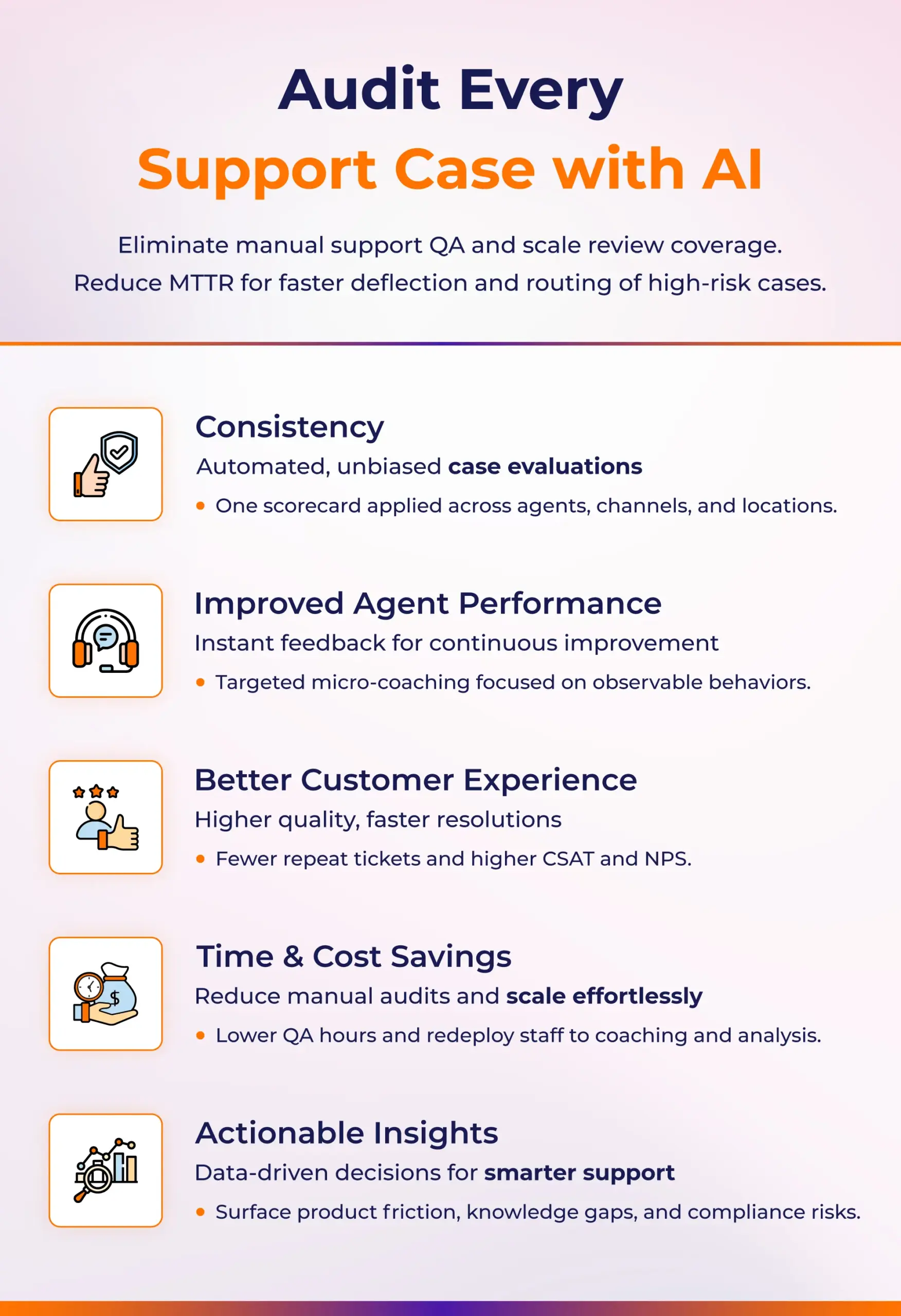
Compliance is another major payoff. A single missed violation in the 98 percent of unreviewed interactions can produce fines that dwarf the QA budget. AI systems provide consistent monitoring, audit trails, and early warning, which dramatically reduce regulatory risk.
For distributed operations, AI solves the consistency problem. Whether agents work in Manila or Milwaukee, they are evaluated against identical criteria. That enables fair comparisons, transparent development programs, and consistent standards across locations.
Finally, the insights from comprehensive QA extend beyond the contact center. Product teams learn which features create friction. Marketing gains clarity on customer language and intent. Operations uncovers systemic process failures that individual ticket reviews would never reveal.
5 Must-Have Features in Enterprise AI Quality Auditing
Not all AI quality auditing platforms are created equal. As enterprises evaluate solutions, certain capabilities separate systems that deliver genuine business value from those that create more problems than they solve. However, to generate true business value, some features are non-negotiable. Here are the 5 pivotal features that quality audit requires.
1. Explainable, Evidence-Based Scoring
Crucially, QA audit fuels self improvement in support. Ergo, AI audit needs to explicitly elucidate on its scoring logic. An agent receives a quality score of 72, but no one can explain why. This opacity destroys trust and makes improvement impossible.
Enterprise-grade AI quality auditing ensures every score is explainable, backed by clear evidence tied directly to the case conversation. When an evaluation flags an empathy issue, the system points to specific conversational turns where empathy was lacking. When it identifies a compliance violation, it highlights the exact language that triggered the flag.
Why this matters: Quality managers need to defend scoring decisions to agents, leadership, and potentially regulators. Without evidence-based explanations, QA becomes a black box that generates resentment rather than improvement. Explainability builds trust, enables targeted coaching, and ensures audit readiness.
2. Human in the loop Agentic AI automation
The black-box problem plagues many AI systems. If the system keeps operating behind closed doors, offering no levers for controls, then trust evaporates and accountability becomes impossible. Human-in-the-loop (HITL) design transforms AI from an unpredictable ‘black box’ into an interactive ‘glass box,’ ensuring that critical decisions remain subject to human oversight, intervention, and ethical calibration.
Effective platforms incorporate review and override workflows where authorized users can validate AI-generated scores and make adjustments based on context the algorithm might miss. Every override requires justification, creating accountability while preserving human judgment.
Why this matters: This approach ensures that human expertise serves as the strategic steering wheel for high-velocity AI capabilities. By integrating expert oversight, organizations can harness the full scale of agentic intelligence while maintaining the ultimate authority to fine-tune complex outcomes.
See how SearchUnify AI Case Quality Auditor transforms enterprise support operations
Register Now3. Admin-Driven Quality Standards
Enterprises define quality differently based on their industry, customer base, and brand values. One company prioritizes speed, another emphasizes thoroughness. For instance, financial services require a different compliance language than hi-tech support.
Rather than imposing fixed scoring models, enterprise platforms allow administrators to configure what “good quality” means through customizable parameters and weights. Organizations can emphasize the dimensions that matter most to their specific context.
Why this matters: Generic quality definitions fail in enterprise environments. Healthcare support quality looks fundamentally different from SaaS product support quality. Configurable standards ensure the AI evaluates what actually matters to your business rather than optimizing for generic benchmarks that don’t align with strategic priorities.
4. Governance and Audit Readiness Built In
Enterprise operations require transparency and accountability. When quality decisions impact performance reviews, compensation, or compliance reporting, every evaluation must be traceable and defensible.
Robust platforms incorporate several governance capabilities. Guardrail-driven evaluation constrains AI scoring to admin-defined parameters, preventing speculative judgments. Evidence-grounded analysis ensures scores derive strictly from case conversation context, eliminating hallucinations. Complete audit trails log every score, override, configuration change, and reviewer action with versioning.
Why this matters: Regulatory compliance, internal audits, and legal defensibility all depend on transparent, traceable quality decisions. When an employee grievance challenges a performance review or a regulatory audit examines compliance procedures, you need complete documentation showing exactly how quality determinations were made and who made them.
5. Scalable Coverage Without Accuracy Trade-offs
Volume should not force compromise between coverage and accuracy. Systems that evaluate 100% of conversations but generate unreliable scores create more work than they eliminate.
Enterprise platforms achieve scale while maintaining precision by combining AI efficiency with strategic human oversight. AI handles comprehensive evaluation across all interactions. Human reviewers focus on validation, coaching, and the complex edge cases that require expert judgment.
Why this matters: Organizations need both breadth and depth. Comprehensive coverage identifies systemic patterns and emerging issues. Accurate evaluation enables fair agent assessment and meaningful improvement programs. Scalability without accuracy is measurement theater. Accuracy without scale does not benefit fully from manual QA pivot.
Beyond Features: Early Risk Detection
Leading platforms now extend quality auditing beyond individual case evaluation to strategic risk identification. By analyzing aggregated quality signals across customer accounts, organizations can identify early warning signs like declining case quality, repeated SLA breaches, or negative sentiment patterns that suggest churn risk.
This capability transforms quality assurance from a reactive measurement exercise into a proactive customer retention tool. Support leaders can intervene before small quality issues compound into account losses, aligning quality metrics directly with business outcomes.
Key Evaluation Parameters in Enterprise Support QA
While the principles of AI quality auditing sound compelling, the real question is: what does this look like in practice? The best enterprise support QA follow structured
SearchUnify AI Case Quality Auditor evaluates every support interaction against a comprehensive framework designed for enterprise support operations. Unlike generic sentiment analysis or basic keyword matching, this system applies sophisticated AI evaluation methods across ten critical quality dimensions that directly impact business outcomes.
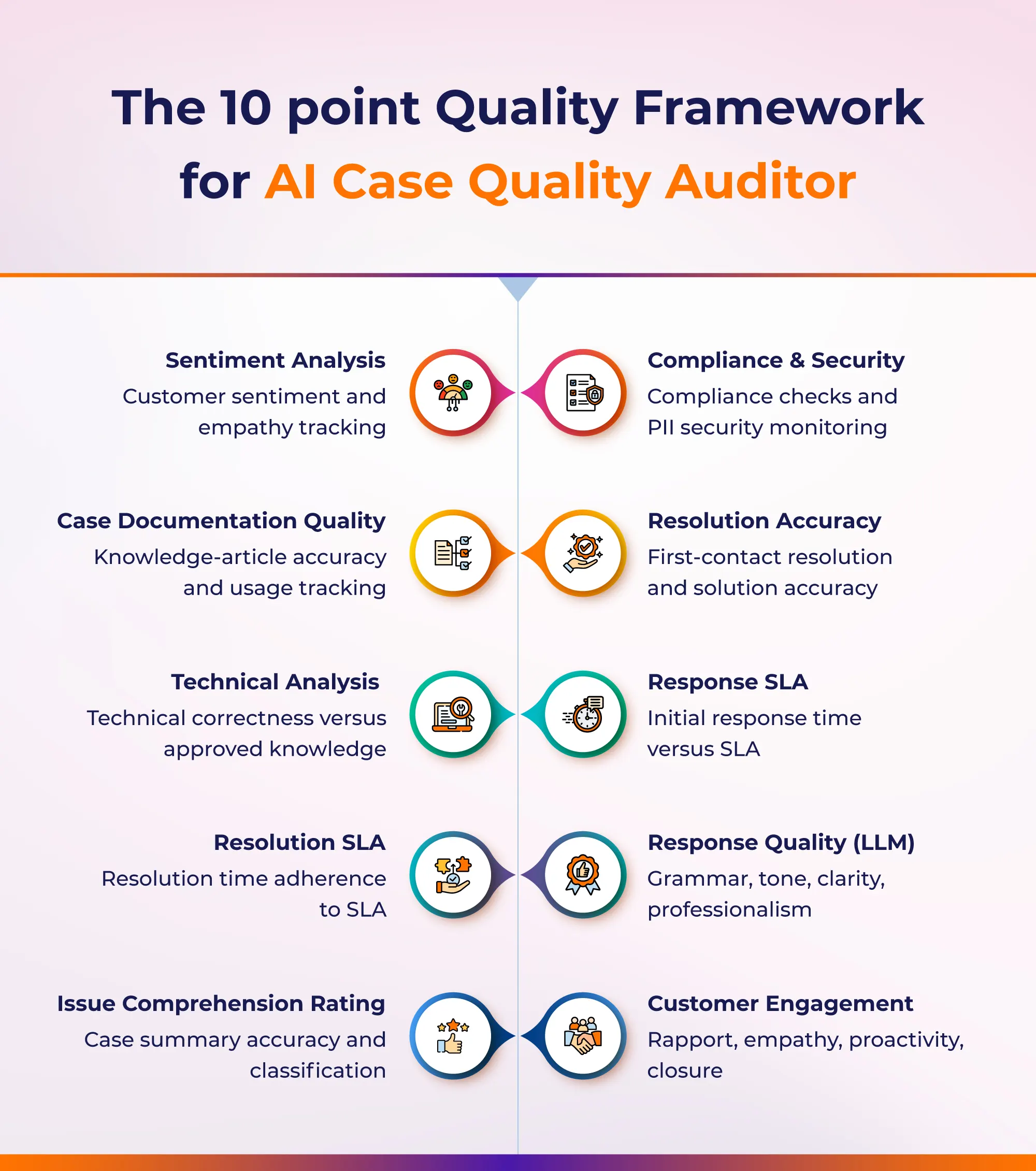
Each parameter receives an AI-generated score that feeds into an overall quality rating. More importantly, the system identifies specific coaching opportunities for individual agents and reveals systemic patterns indicating process gaps or training needs.
The result? A quality assurance program that operates continuously, evaluates comprehensively, and provides actionable insights that improve support operations.
Quality as competitive advantage
Customer expectations keep rising. Responses that were acceptable five years ago now cause frustration. Customers expect consistent, personalized experiences across channels. They share both praise and complaints widely.
In this environment, support quality becomes a competitive differentiator. Enterprises that deliver consistently excellent experiences build loyalty, reduce churn, and generate organic growth. Those that do not will lose customers to competitors that invest in service excellence.
AI case quality auditing helps support organizations meet those expectations at scale. Complete conversation analysis identifies issues before they hit satisfaction scores. Consistent evaluation creates clear performance standards. Real-time insights enable rapid response to emerging problems. And, critically, audit insights form the pivotal self-improvement engine, catalyzing sustainable CX growth, fostering agents’ coaching in the enterprise.
The leaders in customer experience treat QA as a strategic capability rather than a compliance checkbox. They define quality in their own context. They combine human expertise with technological scale. They use comprehensive quality data to drive continuous improvement across the whole support operation.
The choice facing support leaders
The manual support QA challenges are solvable. The real question is whether your organization will solve it before your competitors do.
Join our product innovation webinar
We are hosting a product innovation webinar that goes beyond surface-level AI hype and shows how SearchUnify AI Case Quality Auditor transforms enterprise QA.
You will learn:
- How leading organizations achieve 100 percent quality coverage without expanding QA headcount
- Which quality dimensions AI evaluates reliably and which dimensions still require human judgment
- Implementation approaches that deliver measurable ROI within a few months.
- Integration patterns that work with existing support stacks and workflows
- Governance frameworks that make AI QA sustainable
This session is designed for support leaders, quality managers, and customer experience executives in enterprise organizations. Register now to secure your spot and receive the recording if you cannot attend live.


