




 Last Updated: November 18, 2025
According to a Salesforce survey, 65% of support agents say they receive more complex cases than ever.
As support cases become more complex, organizations increasingly rely on L2 agents. These specialized teams have the expertise to resolve critical issues and act as a bridge between L1 support and SMEs, closing knowledge gaps caused by the scale and intricacy of modern systems.
In this blog, we’ll explore the role of L2 agents, the challenges they face, and how to mitigate these hurdles with customer support automation for greater efficiency.
Table of Contents
- The Role of L2 Agents
- Key Challenges Hindering L2 Support Efficiency
- Smarter Support Through L2 Automation
- FAQs
What is the Role of L2 Agents in Customer Support?
Imagine a customer asks a complicated troubleshooting query or a problem that requires multi-step resolution, L1 can’t solve it. That’s where L2 agents step in. It offers timely resolution, ensuring support efficiency and enhancing customer satisfaction.
L2 agents are responsible for managing escalated tasks because they require substantial knowledge of the business process, and policies. They also need the ability to utilize rational thinking and logical approach or rules while resolving customers’ queries.
As modern industries evolve and grow to be more intricate, these support agents are expected to have diverse skill sets and extensive knowledge about organizational systems.
Moreover, for better support outcomes, agents need insights into the customers’ mood and query context to respond quickly and accurately. In fact, 26% of support agents say they often lack context about a customer’s situation. (source: Salesforce)
This leads to delayed resolutions, repeated escalation, poor customer experience (CX), increased operational costs, and metrics like First Contact Resolution (FCR), Customer Satisfaction (CSAT), and Average Handle Time (AHT) suffer.
Let’s understand what challenges L2 agents face and how they impact the customer and the organization.
What Challenges Do L2 Agents Face in Modern Customer Support?
When customer support automation is not there and the support team has to carry the weight of everything manually, they become overwhelmed, affecting organizational outcomes. Here are the challenges encountered by L2 agents.
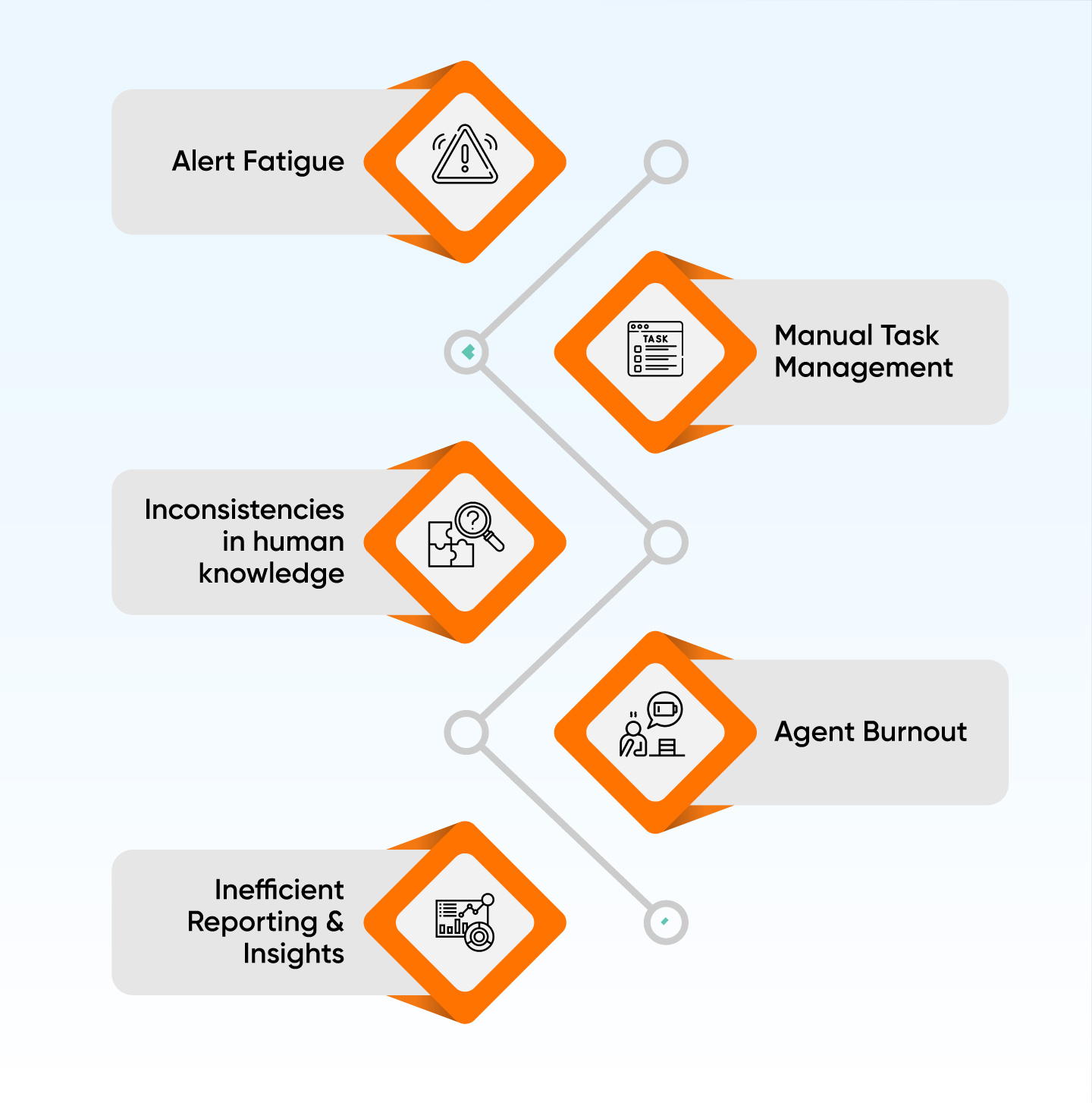
Alert Fatigue
When the support team receives excessive notifications, it can lead to alert fatigue. Each alert has a different level of significance; some might be important, while others can be checked later.
However, when agents are swamped with alerts, sometimes critical notifications go unnoticed, which slows down response and frustrates customers.
Manual Task Management
Handing repetitive tasks manually, such as creating or updating support tickets, is not just time-consuming but prone to errors, too. As the number of tasks increases, the possibility of errors also increases.
Additionally, L2 support agents are often pressed for time to solve complex problems that actually require their attention. The result? It increases the resolution time, operational cost, and jeopardizes the customer experience.
Inconsistencies in Human Knowledge
It’s challenging for the L2 agents to retain all the information about the organization, their policies, products, and others. For instance, when L2 agents are new to the system, they often struggle to navigate complex processes and locate the right information quickly.
Similarly, in organizations with vast and constantly evolving knowledge bases, even experienced agents can find it challenging to stay updated. This results in cognitive overload and difficulties in troubleshooting and resolving issues effectively.
Agent Burnout
Repetitive queries, pressure to provide quick resolution, and switching rapidly between multiple cases and systems, especially when prioritization is lacking, result in agent burnout. It further lowers agents’ productivity and morale, and indirectly affects customer satisfaction.
According to Salesforce, 56% of support agents say they’ve experienced burnout at work.
Inefficient Reporting & Insights
L2 agents usually rely on manual reporting, which includes metrics such as case trends, recurring issues, or resolution time, when analytics tools aren’t available. Therefore, analyzing and generating insight from the report is quite time-consuming and challenging, preventing proactive improvements.
Want to reduce support complexity and take the next step toward smarter support?
Let’s ConnectTo address these challenges, service organizations are turning to customer support automation to enable significant efficiency at scale. In fact, 83% of decision makers plan to increase investments in customer support automation in 2025. (source- Salesforce)
AI Competency Agent: Driving L2 Efficiency with Customer Support Automation
As the customer base and their expectations grow, support teams face a higher volume of diverse and technically complex issues, making it harder for L2 agents to manage them efficiently.
That’s where AI competency agent steps in, an agentic AI-driven L2 engineer that autonomously handles complicated queries through stepwise troubleshooting, delivering precise, accurate, and effective resolution.
How Does AI Competency Agent Help?
Round-the-clock L2 Support
AI competency agent is a game-changer, providing always-on L2 support without fatigue. It leverages a reasoning approach to make context-aware decisions. It checks the complete case history and past resolution to create personalized responses, maintaining consistent support quality, and ensuring exceptional customer experience.
While it handles complex queries efficiently, only strategic tasks with high priority that require human agents are escalated to them. It not only reduces alert fatigue and agent burnout but also enhances their productivity and morale.
Smarter Decision-making
AI Competency Agent delivers efficient reporting & actionable insights that drive intelligent decision-making. By analyzing multi-system inputs, performance trends, and resolution patterns, it identifies improvement areas and automation opportunities.
It also uncovers trends, knowledge gaps, and optimization possibilities, empowering teams to boost efficiency and minimize escalations.
Automated Case Resolution
AI Competency Agent autonomously diagnoses and analyzes support cases that require multi-step resolution using data from tickets, logs, and monitoring systems. It then applies reasoning to resolve issues end-to-end or intelligently escalates only when human expertise is truly needed.
Consistent Support, Every Time
AI Competency Agent seamlessly connects with ITSM tools, CRMs, monitoring platforms, knowledge bases, and backend systems to gather data and execute actions.
Instead of relying on static knowledge bases, it dynamically analyzes each case and understands the customer’s context, intent, and emotion. It then searches connected knowledge sources for relevant information and delivers consistent, context aware resolutions every time.
Since your CX has a direct correlation with how fast the support team resolves customer queries accurately, AI competency agent does this job brilliantly.
Want to know more about how the AI Competency Agent streamlines L2 operations?
Click here!
Frequently Asked Questions
1. What is the L2 support role?
L2 support agents handle complex issues beyond L1 capabilities. They troubleshoot escalated cases, leverage internal knowledge, and often coordinate with SMEs to provide accurate solutions. Their role ensures faster, more reliable resolutions, bridging gaps between frontline support and advanced technical expertise.
2. What are L1, L2, and L3 support?
- L1: Handles basic queries and initial troubleshooting.
- L2: Resolves complex or escalated issues.
- L3: SMEs or specialists solving advanced technical problems.
3. How do L2 agents differ from L1 support agents?
L2 agents have more profound technical expertise, handle complex escalated cases, and make more autonomous decisions. L1 agents follow scripts and manage routine issues. L2 teams troubleshoot intricate problems and coordinate with SMEs to ensure accurate resolutions.
4. How can automation support L2 agents?
Automation streamlines workflows by prioritizing tickets, retrieving relevant knowledge, and reducing repetitive tasks. AI recommendations help resolve complex cases faster, while minimizing errors and cognitive overload. This allows L2 agents to focus on high-value problem-solving, improving efficiency and customer experience.


