





 Last Updated: November 27, 2025
Why Now Is the Right Time to Automate?
In an era of rising customer expectations and increasingly complex customer service landscapes, contact center automation is a present necessity. With rising query volumes, workforce challenges, and pressure to improve customer experience, many support leaders are turning to AI-powered solutions to reduce costs and improve customer service delivery.
But before jumping in, one key step stands between ambition and action: building a compelling business case. Whether you’re looking to automate FAQs, integrate artificial intelligence into workflows, or deploy machine learning to enhance quality assurance, your stakeholders will want more than hype; they’ll want proof of return on investment (ROI) and long-term impact.
In this blog, we are going to discuss how to create a data-backed, stakeholder-aligned business case for contact center automation. Let’s get started.
1. Why Contact Center Automation Is a Business Imperative
The benefits of contact center automation go beyond cost savings. Done right, it enhances operational efficiency, empowers human agents, and drives higher customer satisfaction. Here’s what makes it worth the investment:
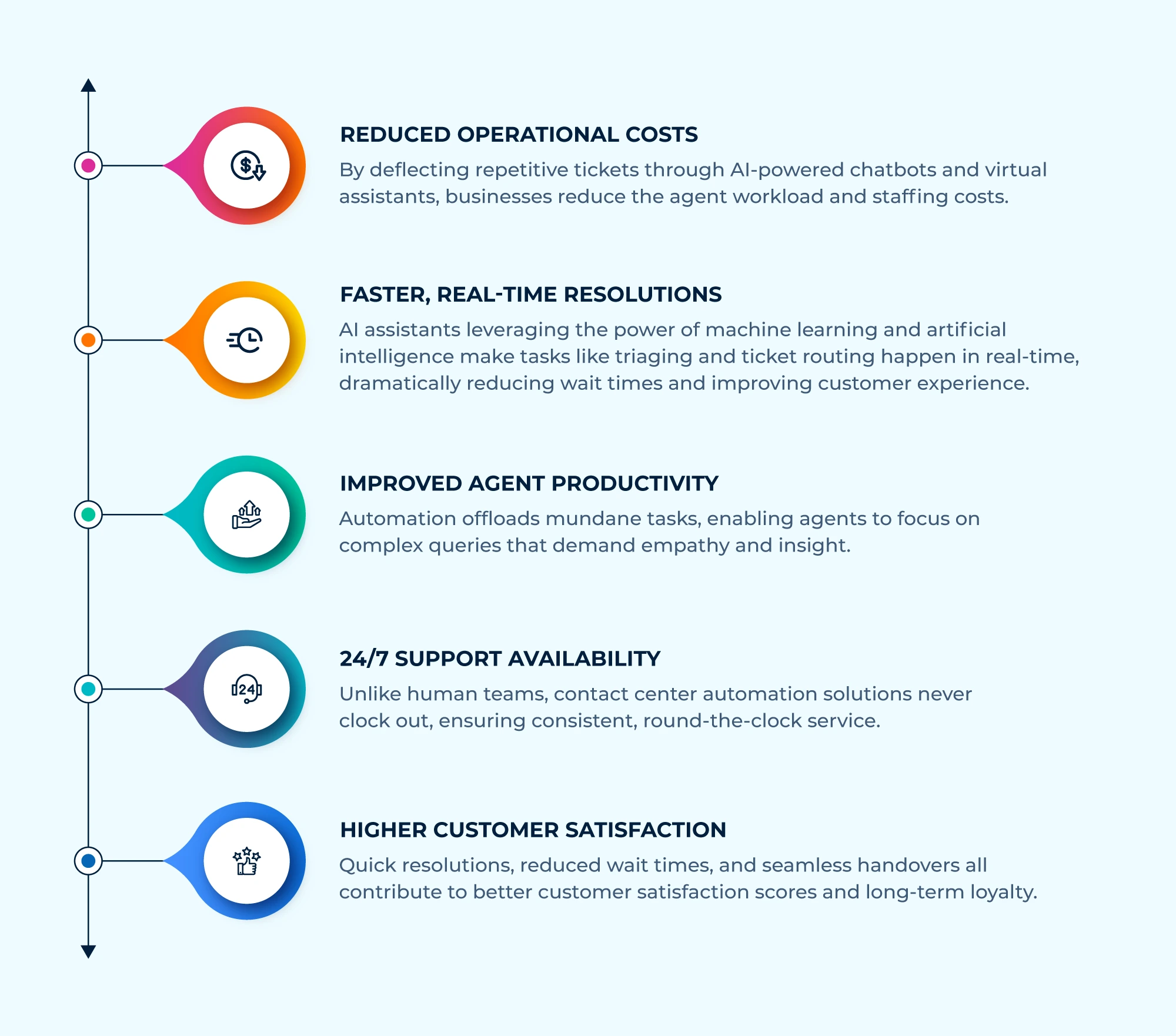
2. Identify Automation Opportunities Based on Pain Points
The first step in building your case is identifying the specific pain points in your contact center that automation can solve. These typically include:
- High-volume, low-complexity queries
- Manual, error-prone processes
- Repetitive tasks that frustrate agents
- Inconsistent knowledge delivery impacting quality assurance
Common Use Cases for Contact Center Automation
| Task | Automation Fit | Benefit |
| Password resets | ✅ High | Frees agent bandwidth |
| Order tracking | ✅ High | Enables 24/7 real-time updates |
| FAQ handling | ✅ High | Reduces contact volume |
| Internal knowledge lookup | ✅ Moderate | Enhances operational efficiency |
Focus on areas that have measurable outcomes and clear value alignment.
3. Quantify the Impact: Cost, CX, and ROI
A strong business case needs data. Here’s how to quantify the return on investment of contact center automation:
a. Cost Reduction
- Decreased Average Handle Time (AHT)
- Reduced live-agent contact volume
- Lower training and onboarding expenses
- Improved agent retention due to lower burnout
Example: If automation deflects 40,000 of 100,000 monthly tickets at $5 per interaction, that’s a potential monthly saving of $200,000, boosting your ROI projection.
b. Improved Customer Experience
- Faster real-time resolutions
- Higher First Contact Resolution (FCR)
- Personalized responses via AI-powered assistants
- Increased customer satisfaction and loyalty
c. Enhanced Operational Efficiency
- Agents handle more complex, high-value queries
- Automated knowledge surfacing improves resolution accuracy
- Standardized workflows ensure better quality assurance
4. Align Automation With Business Goals
To get buy-in, align contact center automation with strategic objectives:
- Customer-Centricity: Consistently deliver high-quality, personalized support using artificial intelligence.
- Scalability: Grow operations without increasing support costs linearly.
- Digital Transformation: Position automation as part of your AI-powered modernization journey.
- Compliance & Quality Assurance: Use bots to enforce consistent responses and reduce manual errors.
When automation aligns with enterprise-level goals, it becomes a strategic advantage, not just a tech upgrade.
5. Address Objections with a Risk Mitigation Plan
Stakeholders will have concerns. Here’s how to address them confidently:
| Objection | Solution |
| “Will automation replace agents?” | No. It augments human agents and enhances engagement by removing repetitive tasks. |
| “What if it gives the wrong answer?” | Use machine learning and human-in-the-loop reviews to improve accuracy over time. |
| “Is it secure?” | Leading vendors offer enterprise-grade encryption, audit trails, and compliance controls. |
6. Present a Strong ROI and Payback Period
Your leadership team will want to see concrete financial outcomes. Here’s how to frame it:
- Total Cost of Ownership (TCO): Includes implementation, licenses, and training
- Quantified Savings: Labor cost reduction, increased efficiency
- Time to Value: How quickly automation will start generating benefits
- Payback Period: Typically within 3–6 months for high-impact use cases
ROI Formula Example: If your annual automation investment is $150,000 and savings reach $400,000 annually, your ROI is ~167% with a payback period under 5 months.
Final Thoughts
Contact center automation is no longer optional; it’s essential for companies that want to scale efficiently, retain talent, and deliver exceptional customer experiences. With the right combination of artificial intelligence, machine learning, and quality assurance frameworks, you can build an automation strategy that’s not only effective but sustainable.
When done right, the results go beyond cost savings. You build a smarter, more responsive contact center that evolves with your customers’ needs for the long term.
That’s exactly what SearchUnify helps you achieve. Our Agentic AI suite focuses on an AI-first approach that enables enterprises to resolve key pain points, improve agent effectiveness, and maximize return on investment through scalable, intelligent solutions. If you’re ready to build a smarter, more future-ready support operation, we’re here to help you make the business case and deliver on it.
Connect with our experts to explore how SearchUnify can transform your contact center into a true engine of growth.


