




 Last Updated: January 15, 2026
AI agents are changing how companies handle customer service, but figuring out what they actually cost isn’t straightforward.
The real costs include setting up the system, training it to work with your business, paying for each conversation or API call, hiring people to monitor and fix problems, and keeping the technology updated over time. If you’re thinking about adding AI agents to your customer service team, you need to know all these costs upfront. Understanding the full picture helps you decide if it’s worth the investment and prevents unexpected expenses that could catch you off guard later.
Table of Content
- Why AI Agent Costs Matter Now
- What Are the Planned Costs to Build AI Agents?
- What Costs Emerge During the AI Agent Build Phase?
- What Are the Ongoing Costs of AI Agents Once Deployed?
- Build vs Buy: Which Makes Financial Sense?
- How Do AI Agents Like SearchUnify Help Enterprises?
Why AI Agent Costs Matter Now
The urgency is driven by scale.
According to Statista, the global AI market is expected to reach $243.70 billion in 2025, with projections rising to $826.70 billion by 2030. Within that, AI agents are one of the fastest-growing segments.
Customer service is one of the most common entry points. Enterprises are deploying AI agents to reduce ticket volume, support agents, and provide 24/7 assistance across channels.
Yet many CX leaders underestimate what it takes to make these systems work reliably at scale. Early planning often focuses on:
- Which LLM to use
- How quickly the agent can be launched
Critical realities are missed:
- Data is fragmented and unprepared
- Integrations are deeper than expected
- Security and compliance slow everything down
- Ongoing operational costs never stabilize
The result is a widening gap between expectations and production reality.
What Are the Planned Costs to Build AI Agents?
When AI agent initiatives are scoped, these costs usually appear first in budgets and business cases.
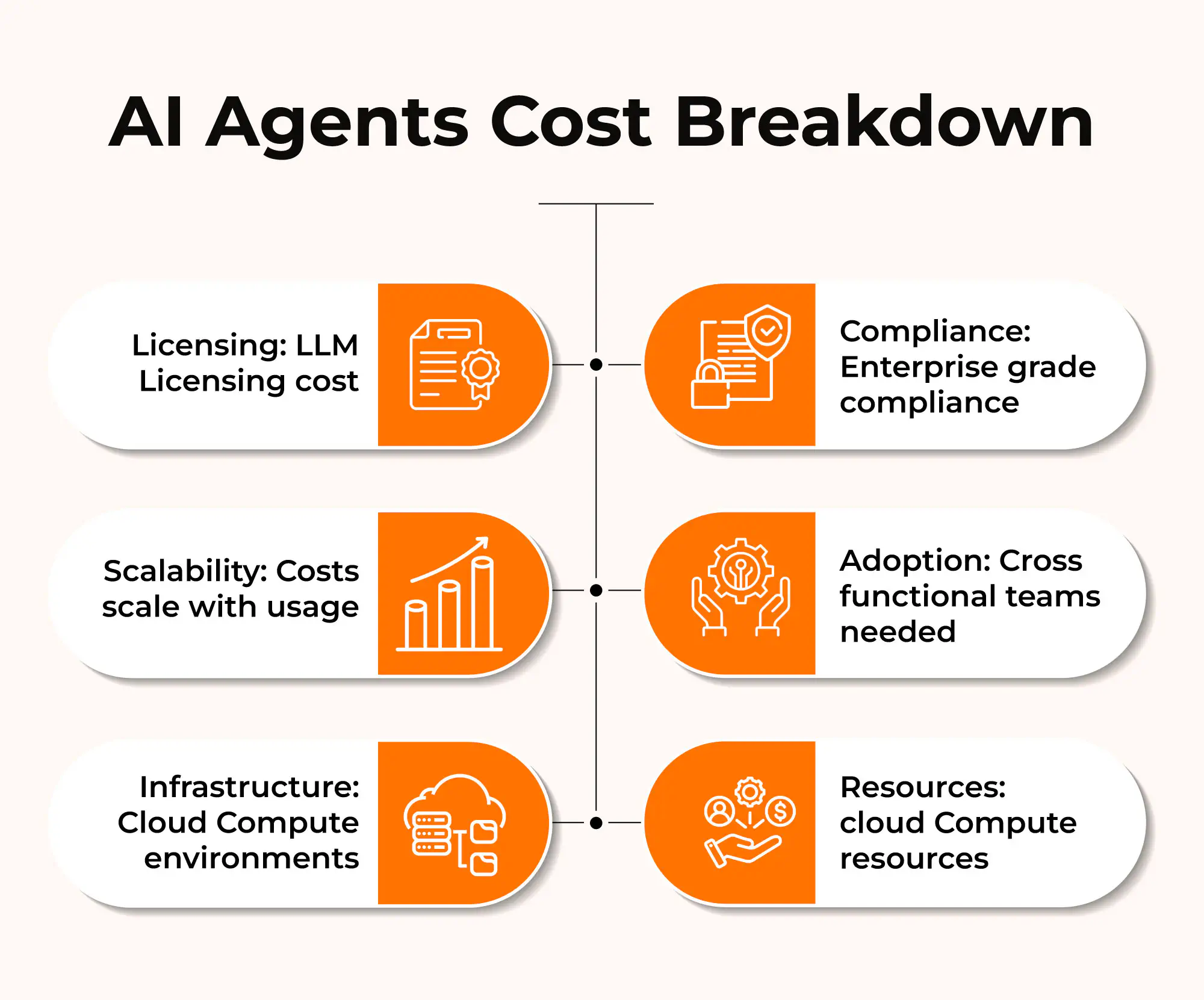
These line items reflect the planned and expected costs, the ones most teams account for early. However, the moment implementation begins, a second layer of costs emerges – driven by data, integrations, infrastructure, and governance. These build-phase costs are less visible upfront, but they are often the biggest contributors to long-term TCO.
What Costs Emerge During the AI Agent Build Phase?
a. Data preparation & knowledge readiness
Drives high upfront effort and continuous rework. Enterprise knowledge changes constantly, requiring repeated cleanup, validation, and reindexing throughout the agent’s lifetime. Industry research indicates that data preparation accounts for 60-75% of the total project effort in analytics and AI initiatives, making it one of the most time-consuming and often underestimated components of customer service AI deployment.
b. Integration complexity
Creates compounding engineering costs. Every CRM, ticketing, or identity integration requires building, testing, and long-term maintenance as systems evolve.
c. Retrieval infrastructure
Scales with usage and content growth. Storage, indexing, and query workloads increase steadily, raising lifetime ownership costs. For instance, AWS highlights that storage, query volume, and operational overhead can become significant at enterprise scale.
d. Security, compliance, and governance
Delays time-to-value and adds permanent operational overhead through audits, access controls, and regulatory upkeep.
In numbers: Agentic AI Cost during the build phase
| Phase | Component | Estimated Cost (USD) |
| Initial Build & Setup (3-6 months) | Data preparation & knowledge structuring | $30,000 – $60,000 |
| System integrations (CRM, ticketing, identity) | $20,000 – $40,000 | |
| Core agent logic, orchestration & testing | $20,000 – $50,000 | |
| Subtotal (Build Phase) | – | $70,000 – $150,000 |
What Are the Ongoing Costs of AI Agents Once Deployed?
Once AI agents move into production, ongoing costs start ballooning. These operational expenses persist throughout the AI agent’s lifecycle and play a major role in long-term total TCO. This is where the real cost of AI agents lives. And it’s unavoidable.
Below is what ongoing AI agent ownership actually looks like in production.
1. LLM Usage and Token Costs
Every interaction with an LLM consumes input and output tokens, including retries, longer contexts, and multi-step reasoning, which quickly increases costs.
- GPT-4 Turbo costs around $0.01-$0.03 per 1,000 tokens.
- A mid-sized product with ~1,000 daily users having multi-turn conversations can use 5-10 million tokens/month.
- Additional retries, fallbacks, and extended prompts further raise the bill.
Even moderate usage can generate significant hidden expenses that often only become apparent when invoices arrive.
2. Infrastructure and Retrieval Layer
RAG-enabled agents require:
- Vector databases.
- Supporting infrastructure for embeddings, caching, and query scaling
3. Monitoring and Observability
Visibility into agent decisions is essential, including logs and traces. Tools like LangSmith, OpenPipe, or Helicone can help, or you can build your own solution.
4. Prompt Updates and Behavior Tuning
Ongoing prompt tuning is critical. Expect 10-20 hours/month of testing and updates.
5. Security and Access Control
Agents handling real business data require:
- Role-based access, logging, and API gating
- IAM, encrypted storage, and traffic throttling
Overview: Ongoing Costs of AI Agents once deployed?
| Cost Category | Monthly Cost (USD) |
| LLM Usage & Tokens | $1,000 – $5,000 |
| Infrastructure & Retrieval | $500 – $2,500 |
| Monitoring & Observability | $200 – $1,000 |
| Prompt Updates & Behavior Tuning | $1,000 – $2,500 |
| Security & Access Control | $500 – $2,000 |
| Total(monthly) | $3,200 – $13,000 |
| Subtotal (Year-1 Operations) | $38,400-$156,000 |
Based on the build and deployment phases, the TCO looks something like:
Total Cost of Ownership (Year 1)
| Phase | Cost Range |
| Build and set up | $70K-$150K |
| Year-1 operations | $38.5K-$156K |
| Total Year-1 TCO | $108K-$306K |
Get a free AI Agent TCO snapshot and see how different approaches could impact your budget.
Calculate My TCOBuild vs Buy: Which Makes Financial Sense?
Given the escalating costs outlined above, many CX leaders are reconsidering whether building custom AI agents makes sense. While each cost layer may seem manageable in isolation, they compound over time. Custom implementations demand continuous engineering investment and long-term ownership of technical debt. What starts as an innovation initiative often becomes a complex infrastructure responsibility, one most CX organizations never intended to manage.
| Dimension | Building In-House | Buying a Solution |
| Best Fit | Best for complex, highly specific workflows | Suited for common use cases and repeatable tasks |
| Upfront Cost | Significant initial spend ($50K-$300K+) | Lower entry cost ($10K-$100K annually) |
| Ongoing Expenses | Engineering time, infrastructure, model usage, and continuous updates | Subscription fees with optional paid add-ons |
| Data Handling & Security | Full authority over data flow, storage, and compliance | Depends on vendor architecture and policies |
| Model Flexibility | Freedom to choose or fine-tune any model stack | Usually restricted to the vendor’s models |
| Maintenance Responsibility | Managed internally by your team | Managed externally by the provider |
How Do AI Agents Like SearchUnify Help Enterprises?
Platforms purpose-built for CX address enterprise-scale challenges by unifying data access, AI capabilities, and operational workflows in a single architecture.
SearchUnify is a federated cognitive platform designed for customer support environments. It combines AI, machine learning, and behavioral insights to create a unified layer across knowledge bases, support tools, and enterprise applications, reducing fragmentation and eliminating repeated data preparation.
Organizations typically see value through improved self-service, faster case resolution, and more efficient agent workflows. AI-powered search and conversational interfaces work from the same knowledge foundation, ensuring consistency across channels. Built-in analytics provide visibility into user journeys and content performance, while low-code configuration simplifies both implementation and ongoing maintenance.
For CX leaders weighing their options, platforms like SearchUnify demonstrate how enterprise-ready architectures can control the total cost of ownership while supporting scalable AI deployments.
See AI in action
Request a demo of SearchUnify’s Agentic AI Suite and transform your customer service today.
Request a DemoFAQs: Cost to Build AI Agents
1. What determines the cost to build AI agents for different business sizes?
Costs vary depending on the number of users, interaction volume, required intelligence, and the complexity of integrations. Larger enterprises typically face higher costs due to multi-system connectivity and enterprise-grade compliance requirements.
2. How do AI agent features impact the cost to build AI agents?
Advanced capabilities such as natural language understanding, multi-channel support, predictive analytics, and personalization increase development complexity, which drives up the overall cost. Simpler, task-specific bots are less expensive.
3. Can I get a free trial or demo for popular AI agent services?
Yes, many enterprise AI platforms offer trial or demo options to explore features before committing. SearchUnify, for example, provides a hands-on demo of its Agentic AI Suite, allowing organizations to evaluate capabilities, integrations, and potential cost efficiencies.
4. Which AI agent providers offer the most affordable starter packages?
Starter packages vary widely based on features, usage limits, and integration depth. Platforms like SearchUnify offer scalable entry points for teams, helping smaller organizations access AI-powered customer service without high upfront investment.
5. How can I evaluate cost-efficient AI agents for my enterprise?
Focus on platforms that unify AI, knowledge access, and operational workflows. SearchUnify demonstrates a cost-efficient approach by reducing repeated engineering work, simplifying integrations, and providing insights for continuous optimization, helping enterprises lower total cost of ownership.
6. How to forecast and control long-term AI agent costs after launch?
To manage long-term costs, enterprises should look beyond upfront build estimates and model usage-based expenses, ongoing engineering effort, and governance overhead. CFOs and support leaders increasingly favor platforms that offer predictable pricing, built-in compliance, and centralized analytics. Solutions like SearchUnify help control cost creep by minimizing custom maintenance, consolidating tools, and providing visibility into performance and optimization opportunities over time.


