





 Last Updated: December 29, 2025
Agentic AI ROI is quickly becoming the new north star for customer-facing teams, and for good reason.
Support costs are climbing fast. Average ticket volumes have risen since 2020. Hiring gets more expensive. Training takes months. High turnover keeps resetting the clock and the budget.
Agentic AI offers a way out of this loop. It resolves a significant share of tickets without adding headcount, runs 24/7 at near-zero marginal cost, and gets smarter with every interaction. While traditional automation merely saves hours, Agentic AI rewires the entire cost structure of support. That’s why measuring ROI isn’t optional anymore. It’s the new baseline for decision-making.
Let’s look at how support teams can measure, unlock, and scale Agentic AI ROI with the right architecture. To enable that scale, organizations need a modern foundation: an agentic AI mesh that governs, integrates, and orchestrates multiple agents safely and efficiently.
With it, customer support transforms from a cost center into a true engine of growth.
How Do Customer Support Economics Work Today?
Customer support is still one of the most resource-heavy functions in any enterprise. The bulk of operating costs goes toward hiring, salaries, training, quality assurance, infrastructure, and ever-expanding software stacks. High turnover increases these expenses, making predictable scaling almost impossible.
For decades, the only way to keep up with rising ticket volumes was to add more people. That meant support costs increased almost linearly with demand.
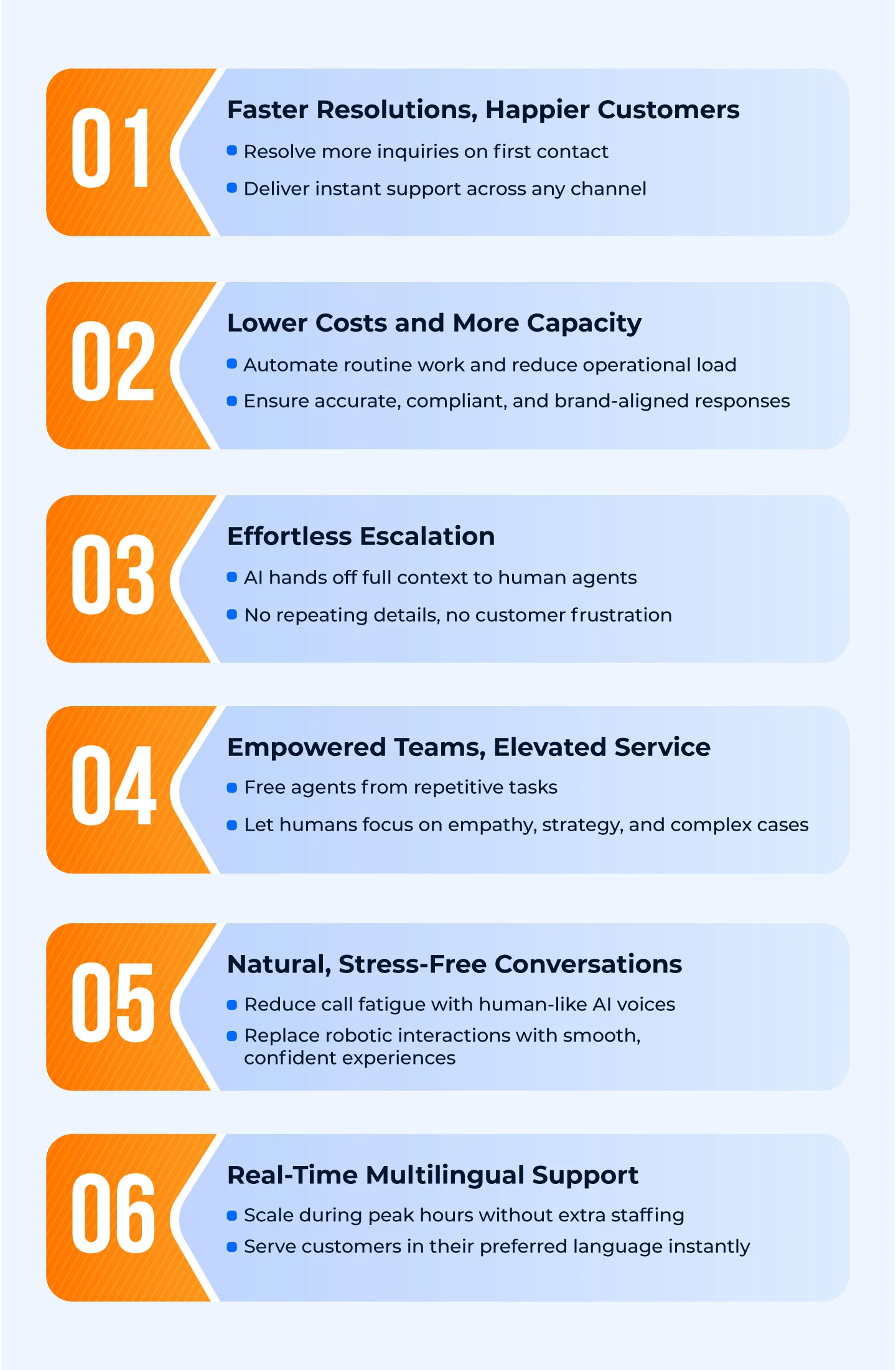
This is the pressure point where modern AI becomes transformative. Instead of tying cost to volume, agentic AI automates a wide range of routine and semi-complex tasks end-to-end. As a result, ticket growth no longer demands equivalent headcount growth. Once deployed, AI agents run continuously at near-zero marginal cost, introducing a completely different economic model for support.
What Is Agentic AI ROI and Why Service Teams Are Adopting It Now?
Agentic AI ROI measures the real, measurable value organizations gain when autonomous agents speed up resolutions, reduce manual work, and lower operational costs. It matters more than ever because service demand is rising sharply while the cost of hiring, training, and retaining support staff continues to climb. Many organizations have adopted generative AI, yet most still struggle to see real impact. Broad copilots and static chatbots help with responses, but they don’t solve workflow complexity or escalating ticket volumes.
Agentic AI changes this equation. Instead of following fixed rules, AI agents understand context, make decisions, and take actions across entire support workflows – classification, routing, knowledge retrieval, escalation, and more. This drives faster outcomes, fewer handoffs, and significant operational savings.
The impact is already visible in real deployments. Verizon’s rollout of Google-powered agentic AI for 28,000 service reps in January 2025 boosted service-led sales by nearly 40% and cut call times by delivering real-time answers and next-best-offer recommendations. As customer expectations rise and legacy systems fall short, service teams are adopting agentic AI not just to automate tasks but to transform how support operates, improve CSAT, and drive measurable ROI at scale.
Build Scalable, AI-Driven Customer Support
Book a DemoWhat Does Agentic AI Change in Support Economics?
Once the cost pressures of modern support operations are clear, the next step is understanding how Agentic AI translates those pressures into measurable financial returns.
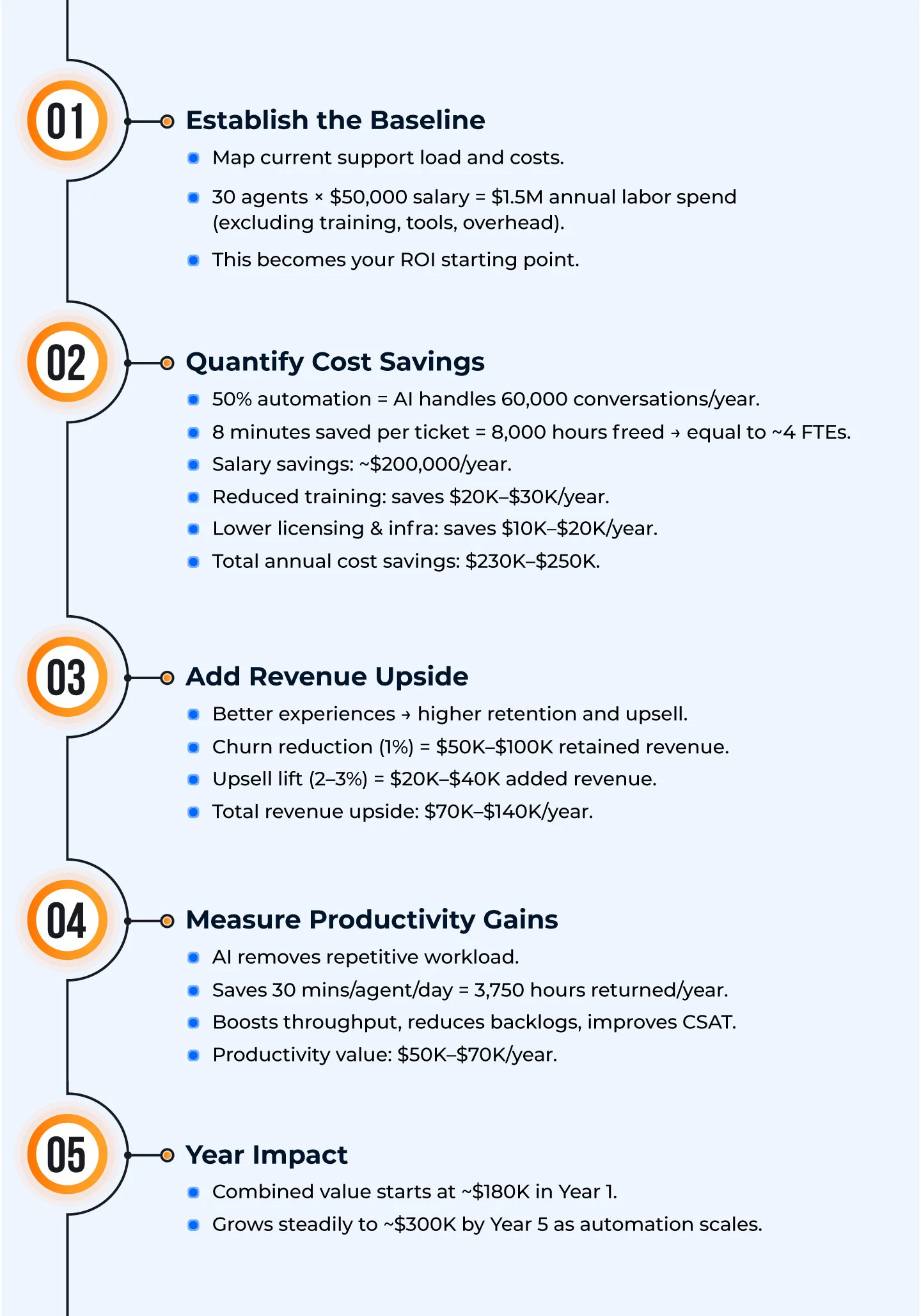
Measuring the ROI of agentic AI in customer service requires blending hard savings (lower labor, training, and operational costs) with value gains such as higher productivity, better customer satisfaction, and improved retention. Using the assumptions below, here’s how to build a practical ROI model.
Assumptions:
- Annual customer conversations: 120,000
- Number of agents: 30
- Average agent salary: $50,000
- Average resolution time: 8 minutes
- Expected ticket growth: 10% per year
- Target automation rate: 50%
The accompanying 5-year projection shows savings growing from about $180K in Year 1 to nearly $300K by Year 5, reflecting how ROI compounds as automation scales with rising ticket volumes.
How SearchUnify Drives Real Agentic AI ROI?
With the ROI framework in place, one can look at how SearchUnify turns these principles into real, measurable outcomes for customer support teams. Most organisations see AI as a way to cut costs in customer support. SearchUnify shows that the opportunity is much bigger. Its Agentic AI Suite transforms the entire support lifecycle, from the first customer message to case resolution, troubleshooting, knowledge creation, and quality auditing. This creates a direct and measurable impact on cost, productivity, and customer experience.
SearchUnify Agentic AI Suite
Unlike isolated chatbots or copilots, SearchUnify integrates Find, Assist, and Act within a single autonomous mesh. This ensures end-to-end coverage across support workflows.
Here’s how the suite delivers tangible value:
1. Faster Resolutions from Day One
The AI Support Agent uses cognitive and federated search to instantly deliver accurate answers, handling FAQs, troubleshooting, and follow-up queries autonomously.
2. Smarter Escalations Without Bot Loops
The AI Escalation Manager monitors sentiment in real time and escalates intelligently when the customer is dissatisfied, ensuring no one gets stuck in a loop.
3. Automated Case Creation and Routing
When human attention is needed, AI creates structured cases, classifies them accurately, and routes them to the right teams.
4. Co-Pilot Tools that Boost Human Productivity
The AI Agent Partner summarizes case history, recommends responses, and connects agents to SMEs through swarming.
Meanwhile, the AI Case Quality Auditor evaluates 100% of cases, replacing manual sampling.
5. Fully Autonomous Knowledge Creation
AI Knowledge Agent converts resolved cases into knowledge articles, cross-referencing content, drafting new material, optimizing for accuracy, and publishing it automatically.
Why It’s Time to Make Agentic AI Your Next Strategic Move
This end-to-end capability sets the foundation, but gaining organizational momentum requires aligning AI value with stakeholder priorities. The strongest business case positions agentic AI as both a cost optimizer and an experience accelerator.
A compelling proposal should include:
- Pilot metrics (deflection, handle time reduction, CSAT/NPS uplift)
- A scalable, extensible architecture
- A plan for workforce augmentation, not replacement
Pro tip: Start with a focused pilot, measure rigorously, and scale into high-impact processes. This creates quick wins, builds confidence, and accelerates enterprise-wide adoption.
Accelerate ROI with SearchUnify’s Agentic AI
Schedule a demoFAQ
1. What is Agentic AI ROI?
It measures the value gained by automating customer support workflows using AI agents, covering cost reduction, faster resolutions, higher productivity, and better retention.
2. How do AI agents reduce support costs?
They automate repetitive tasks, eliminate manual work, and reduce handle time. This reduces labor and operational expenses, enabling teams to manage higher volumes without increasing headcount.
3. Why is Agentic AI more effective than traditional chatbots?
Traditional chatbots follow rigid rules. Agentic AI understands context, reasons dynamically, adapts to changing scenarios, and executes end-to-end actions.
4. How does Agentic AI improve revenue retention and upsell?
Faster, error-free service reduces churn. Removing friction in purchasing and support journeys improves upsell conversions.
5. How does SearchUnify help measure ROI?
SearchUnify provides a structured model that blends cost savings, productivity gains, automation impact, and experience improvements.


